
AI FOR FREIGHT, TRANSPORT AND LOGISTICS
Booking emails and PDFs into your TMS, quotes drafted from your rate card, PODs read and filed, customers updated and carrier invoices checked. Your people approve, plan and keep every safety decision.
EXAMPLE ONLY · NOT A REAL CARRIER OR CUSTOMER
- TUE 7:12 AMBooking email arrives"2 pallets, Smithfield NSW to Dandenong VIC, tail-lift at delivery" with a PDF attached… READ FROM THE BOOKINGS INBOX
- 7:13 AMDraft booking preparedPick-up, delivery, pallets, weight, dimensions and instructions pulled from the email and PDF… OPERATIONS CONFIRMS IN THE TMS
- 7:20 AMQuote draftedRate card lane, current fuel levy and the tail-lift charge, with the working shown… ACCOUNT MANAGER APPROVES
- THU 3:40 PMPOD capturedSigned consignment note photo read: consignment number, receiver name, time, no damage noted… MATCHED TO THE JOB, EXCEPTIONS TO A PERSON
- 3:45 PMCustomer updated"Delivered 3:38 PM, signed for at the dock. POD attached."… SENT FROM THE DELIVERY RECORD
NEVER DONE BY THE SYSTEM
Scheduling drivers or their work and rest hours, deciding who is fit to drive, setting delivery times, loading or mass decisions
the system does the paperwork · your people run the freight
001 / THE SHORT ANSWER
AI helps logistics and transport companies by reading the documents freight runs on: booking emails, PDFs, consignment notes, proof-of-delivery photos, carrier invoices and compliance paperwork, and turning them into records your team can check and approve. The work that keeps operations at their desks after the trucks leave.
The line we build to is simple. The system reads, drafts, matches, answers and reminds. Your people approve quotes, confirm bookings, plan runs, decide disputes and make every decision that affects heavy vehicle safety. Under the Heavy Vehicle National Law, scheduling and safety obligations sit with people and businesses, so a model shouldn't be making those calls.
We're a Sydney-based AI and automation agency working remotely across Australia and New Zealand, and we fly in for kick-offs, training and go-lives. This page is general information, not legal or compliance advice.
002 / WORKED EXAMPLE
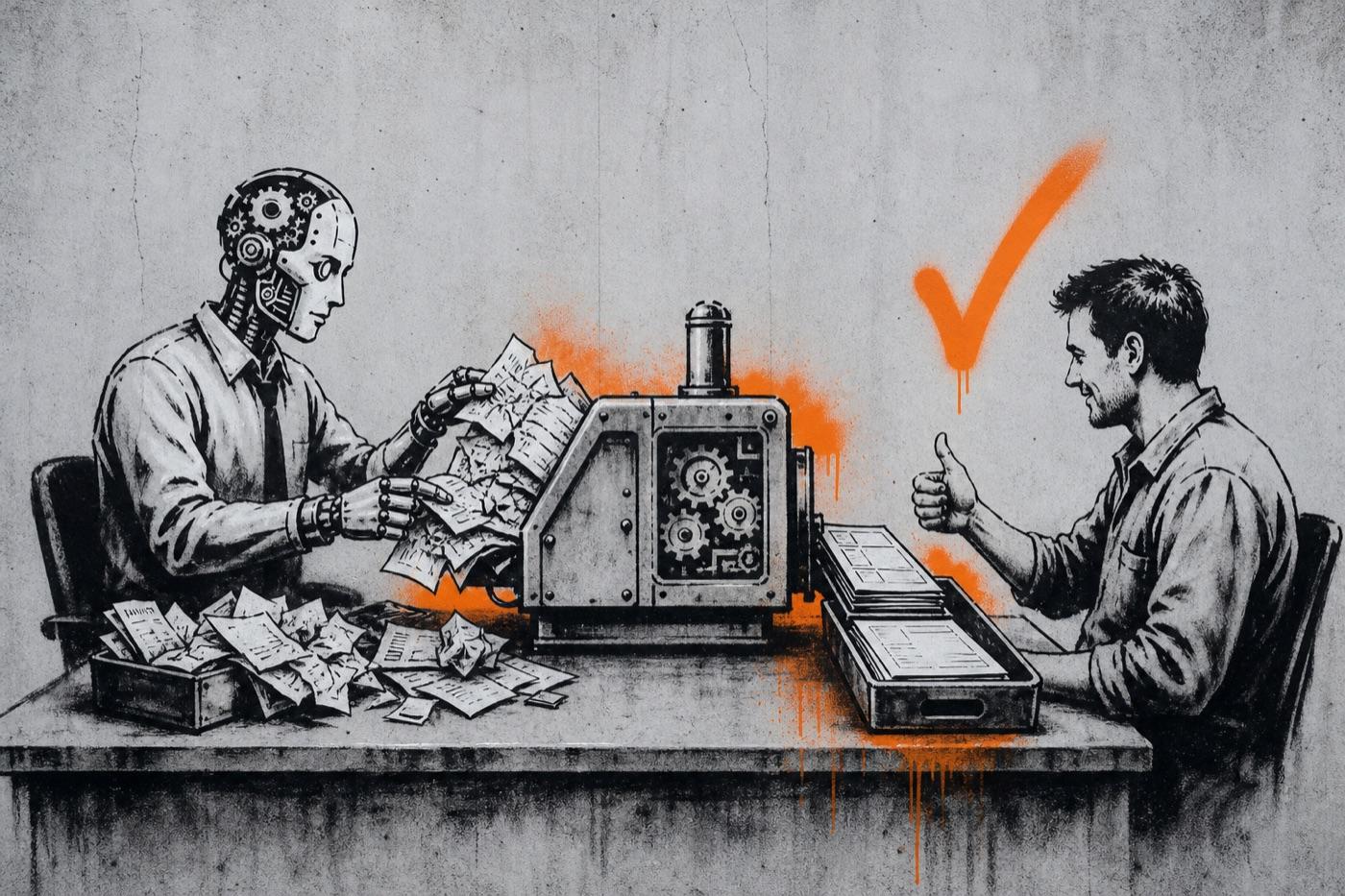
In this example, a booking that arrives at 7:12 AM is a draft booking a minute later, has an approved quote before 7:30, and ends with a POD filed and the customer told within minutes of delivery. It's an illustration, not a real carrier.
- The email. A customer books two pallets from Smithfield to Dandenong, tail-lift at delivery, with a PDF form attached.
- The draft booking. Addresses, pallets, weight, dimensions and references are read from both and a booking prepared. Anything missing, such as the delivery contact, is flagged rather than guessed.
- The quote. The lane comes from your rate card, plus the current fuel levy and tail-lift charge, with the working shown. The account manager approves it.
- The delivery. The signed consignment note photo is read, checked for damage notes and filed against the job.
- The update. The customer gets a delivery confirmation with the POD attached, and the job is ready to invoice.
Nobody retyped the booking or searched for the POD, and the system never touched the run sheet.
003 / WHO DECIDES
Reading, drafting, matching and reminding suit AI well. Planning, scheduling, fitness to drive, loading and anything else that affects heavy vehicle safety stay with people.
| Job | What AI does | Who decides |
|---|---|---|
| OPERATIONS Booking intake | Reads booking emails, PDFs and spreadsheets and prepares a draft booking in the TMS | Operations confirms each booking |
| CUSTOMERS Quote requests | Drafts the quote from your rate card, fuel levy and accessorials, and flags what it can't price | Account manager approves before it's sent |
| OPERATIONS POD and consignment notes | Reads photos and scans, matches the consignment number, records signature, time and damage notes | A person checks unreadable or mismatched PODs |
| CUSTOMERS "Where's my freight?" | Answers from the latest status in the TMS or tracking feed and sends the POD once delivered | Customer service takes delays and complaints |
| ACCOUNTS Carrier invoice checks | Matches invoice lines to consignments and agreed rates, flags differences, drafts clean bills | Accounts approves bills and decides disputes |
| OPERATIONS Compliance document register | Reads expiry dates, keeps the register and sends reminders before anything lapses | Compliance or fleet manager acts on them |
| STAYS WITH PEOPLE Driver scheduling and work and rest hours | Nothing | Schedulers, under your fatigue management system |
| STAYS WITH PEOPLE Fitness to drive, loading and mass | Nothing | Drivers, loaders and managers under the HVNL and your procedures |
General information only, not compliance advice.
004 / QUOTES AND BOOKINGS
It reads each request wherever it arrives, turns it into structured fields, and prepares a draft booking or quote for a person to confirm.
Booking intake into the TMS
The workflow reads emails, PDF forms and spreadsheets from your bookings inbox and pulls out addresses, freight, quantities, weights, dimensions, references and instructions. With a TMS API or import it creates a draft booking for operations to confirm; without one it prepares a clean summary to key in. Our AI email automation page covers inbox sorting and routing in more depth.
Quotes and rate lookups
- Your rates, not the model's. Prices come from your rate card and current fuel levy table. The model never estimates a rate.
- Accessorials listed. Tail-lift, residential delivery, waiting time and other charges are added from your schedule, line by line.
- Unpriceable work flagged. Dangerous goods, oversize freight, unknown postcodes and unusual lanes go to a person with the request summarised.
005 / PROOF OF DELIVERY
Document AI reads each POD photo, signature or scanned consignment note, matches it to the right consignment number, and records who signed, when, and any damage or shortage notes. Clear PODs are filed automatically; the rest go to a person.
- Matching. The consignment number is read from the docket or label and checked against open jobs, so a POD can't be filed against the wrong delivery.
- Exceptions. Handwritten notes like “1 carton damaged” or “short 2” are picked up and raised as exceptions for customer service.
- Low confidence goes to a person. Blurry photos, missing signatures or numbers that don't match are queued for review, never guessed.
The same approach handles pick-up dockets, delivery dockets and supplier paperwork. See document AI for how we build and test extraction, and document control for filing and versioning.
006 / CUSTOMER UPDATES
Yes, if it answers only from your own tracking data: the latest status in the TMS or tracking feed, the POD once there is one, and nothing it has worked out for itself.
The system finds the consignment from a reference number and replies with what the record says: picked up, in transit, out for delivery, delivered with POD. It doesn't invent an arrival time, and delays or unhappy customers go to customer service. Calls can go to an AI receptionist and web chat to an AI chatbot reading the same status.
007 / CARRIER INVOICES
It reads each carrier invoice, matches every line to a consignment and the agreed rate, and flags what doesn't match before anyone pays it.
- Unbooked charges. A line for a consignment you have no record of.
- Rate differences. A lane charged above the agreed rate, or a fuel levy that doesn't match the agreed percentage.
- Duplicates. The same consignment billed twice, or on two invoices.
Clean invoices become draft bills with the source document attached, in Xero or MYOB, and accounts approves them. Our invoice OCR automation page covers the extraction side.
008 / COMPLIANCE DOCUMENTS
Yes, as a register and reminder system: it reads expiry dates from the documents you already collect and makes sure the right person hears about them weeks before they lapse.
Driver licences and medicals, vehicle registrations, insurance certificates, accreditation paperwork and subcontractor documents are read as they arrive, the expiry date recorded, and reminders sent at the intervals you set. Whether a driver, vehicle or subcontractor can work stays with your compliance or fleet manager.
009 / CHAIN OF RESPONSIBILITY
Because under the Heavy Vehicle National Law, scheduling is itself a chain of responsibility function, and fatigue limits are a safety obligation, not an optimisation problem. In our builds, AI doesn't schedule drivers, set delivery times or decide who takes a job.
Chain of responsibility
The NHVR describes chain of responsibility as the part of the HVNL that makes parties other than drivers responsible for heavy vehicle safety. Each party has a primary duty to ensure, so far as is reasonably practicable, the safety of its transport activities, and executives must exercise due diligence. The ten CoR functions include consignors, consignees, loaders and the scheduler: anyone who schedules the transport of goods in a heavy vehicle, or a driver's work and rest hours. A system setting those schedules would be doing a CoR function, and its errors would be your business's.
Fatigue rules
National fatigue laws apply to fatigue-regulated heavy vehicles, which include vehicles and combinations over 12 tonnes and buses over 4.5 tonnes fitted to carry more than 12 adults. Drivers must keep within maximum work and minimum rest limits, and must not drive while impaired by fatigue. Work and rest are recorded in a work diary, or an electronic work diary approved by the NHVR. Our systems don't keep work diaries or count hours.
What changes, and where
The HVNL applies in the ACT, New South Wales, Queensland, South Australia, Tasmania and Victoria; it hasn't commenced in Western Australia or the Northern Territory. It changed on 1 August 2026, including fatigue and work diary requirements, so check your obligations with the NHVR and your own advisers.
010 / SYSTEMS AND PRIVACY
AI workflows can sit between your inboxes, TMS, tracking feeds, accounting software and document storage, but what can be connected depends on each system and vendor, so we check before quoting.
Your systems
Where your TMS or warehouse system has an API or import, we use it; where it doesn't, the workflow works from emails and exports. For the workflow layer we usually use n8n (see n8n consultants), or Power Automate if you're on Microsoft 365.
Customer and driver data
Consignee addresses, signatures and driver licence details are personal information. Under the Privacy Act 1988 and the Australian Privacy Principles, use only what each job needs. The OAIC's guidance on commercially available AI products recommends, as best practice, not entering personal and especially sensitive information into publicly available generative AI tools. In our builds only the needed fields reach a model, data stays in Australia or your own environment where required (see private AI hosted in Australia), and nothing is used to train public models.
011 / REAL BUILDS
For a logistics broker, we built a Gmail-integrated prototype that reads cargo slot offers and client requests, pulls out route, cargo type, volume and dates, and suggests matches for the broker to confirm.
It's an MVP prototype, and the broker reviews and confirms every match. Read the AI cargo matching case study.
The paperwork side draws on work in other industries. For a trade services business, supplier bills from email become coded draft bills in Xero with four automated checks each, and staff approve every bill (case study). Our invoice reconciliation platform matches remittances to invoices and was measured on 1,000 unseen invoices before go-live. The same matching suits carrier invoices. If you hold and sell the stock as well as move it, see AI for wholesalers and distributors.
012 / HOW WE START
We start with one job, run it next to your current process, and switch over only when your team trusts it. Nothing touches scheduling, fatigue or loading decisions.
- 01
Pick the job
Usually booking intake from emails and PDFs, POD filing, carrier invoice checks or the compliance document register.
- 02
Check the systems
What your TMS, tracking feeds and accounting software allow decides what's practical. We confirm it before quoting.
- 03
Agree the rules
Which fields matter, what needs approval, what counts as an exception and who gets it, written down first.
- 04
Run it in parallel
It works alongside your team on real bookings and PODs so you can compare its output with your own.
- 05
Switch over and review
Go live once you're happy, with every document and decision logged from day one and a review after the first month.

014 / QUESTIONS
Anything else is quicker to answer on a call. Thirty minutes, free, with the people who would build it.
By handling the paperwork: booking emails and PDFs read into your TMS as drafts, quotes drafted from your rate card for approval, PODs and consignment notes read and filed, 'where's my freight?' answered from tracking data, carrier invoices checked, and compliance expiries tracked. People approve quotes, plan runs and make every safety and scheduling decision.
Tell us where your operations or accounts team retypes the most. In thirty minutes we'll sketch the workflow, the approvals and which systems it would touch.
Book a free call→