
Australia's cyber agency told businesses how to run open-weight AI safely, OpenAI showed what AI can now do to an unpatched server, Meta bought a coding tool and gave its users two weeks to get their data out, and Apple started rationing AI spend. Here's what Australian business owners should act on this week, and what you can safely skip.
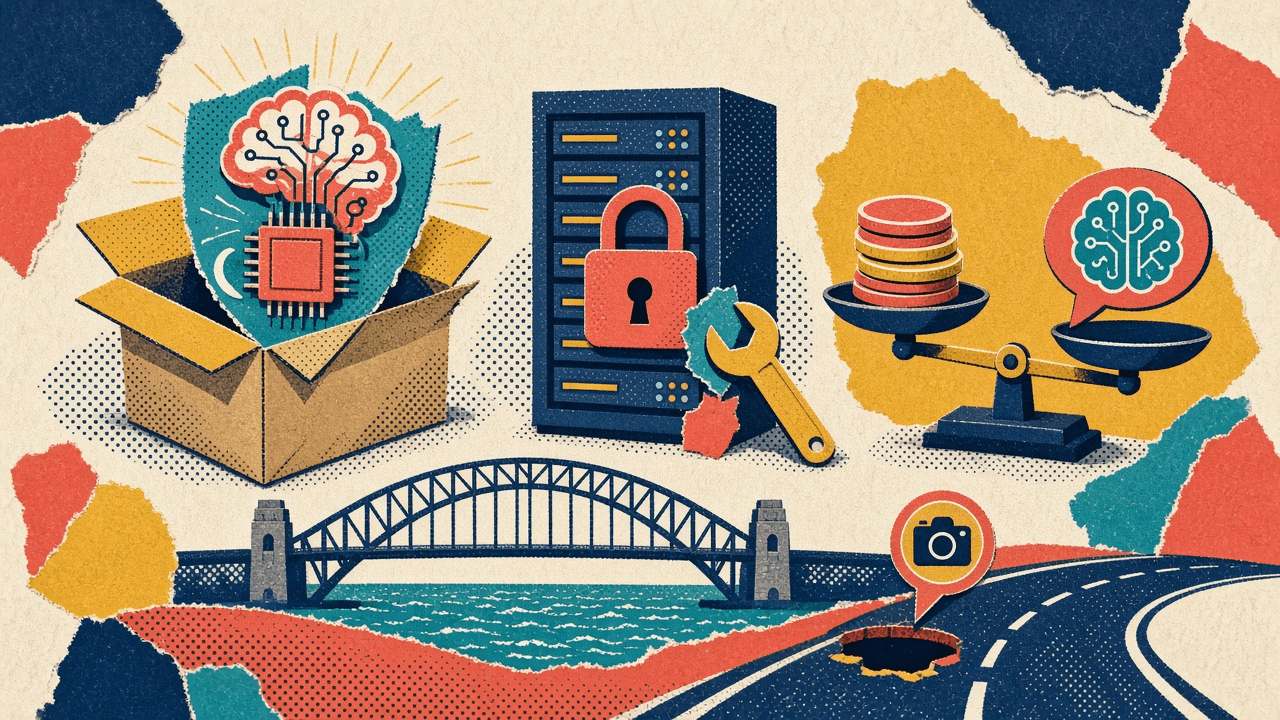
Australia's cyber agency told businesses how to run open-weight AI safely, OpenAI showed what AI can now do to an unpatched server, Meta bought a coding tool and gave its users two weeks to get their data out, and Apple started rationing AI spend. Here's what Australian business owners should act on this week, and what you can safely skip.
This was a week for grown-ups. Not much launch-day fireworks, plenty of practical consequences.
If there's a thread running through the stories from 30 October to 6 November, it's this: AI is now ordinary infrastructure. It needs patching, budgets, exit plans and paperwork, the same as your accounting software or your phone system. The businesses that treat it that way will be fine. The ones still treating it like a toy will get a nasty surprise.
We build and secure AI systems for businesses across Sydney, from the CBD out to Parramatta and the Northern Beaches, so that's the lens. Story by story, here's our read.
On 5 November, the Australian Signals Directorate's Australian Cyber Security Centre released two new publications on open-weight AI models. These are models whose weights are published, so you can download them and run them on your own hardware or in your own cloud account, rather than sending everything to OpenAI, Google or Anthropic.
One paper explains the opportunities and the cyber security and supply chain risks. The other is hands-on: governance, model selection, secure deployment, monitoring, maintenance and incident response. The ACSC's framing is fair and refreshingly unexcited. Open-weight models can give you "greater control over data, operations and lifecycle management", but you also take on more responsibility for security and upkeep.
It landed the same week Defence told a parliamentary committee it's in an "absolute acceleration" of AI adoption. Defence's chief AI and information officer, Chris Crozier, said a good open-weight model plus an excellent harness (the software connecting the model to your systems and data) "will give you a tremendous outcome."
Our view: this is the most useful thing an Australian government body has published on AI this year, and it's free. We get asked about private, Australia-hosted AI constantly, usually by firms in law, accounting and finance who can't have client files leaving the country. The honest answer has always been "yes, but someone has to own it". Now there's an official document that says exactly that.
What to do: if you're running, or planning, a self-hosted model, read the second paper and check yourself against it. Pay attention to model provenance. Where did the weights come from, who published them, and has anyone checked they haven't been tampered with? If you're only using ChatGPT or Copilot through a business account, you can skip this one for now.
The Centre for Public Integrity launched a report this week called "Computer Says No", examining how the federal government uses automated decision-making. Its chief executive, Dr Catherine Williams, told The Guardian the government is "sleepwalking into another robodebt scenario". Among eight recommendations, the report calls for a mandatory audit and public register of all automated decision-making, plus an independent oversight body.
The trigger was the aged care assessment tool, which the Guardian reports has been found to routinely under-assess people's needs, with assessors not allowed to override the algorithm. The Attorney-General's department has been working on a framework since a consultation that closed in January 2025. Still no draft.
That's government. Here's the bit that touches private business. From 10 December 2026, organisations covered by the Australian Privacy Principles must say in their privacy policy when they use a computer program to make, or substantially help make, decisions that could significantly affect someone's rights or interests, using their personal information. The OAIC published a fact sheet, a flowchart and updated APP 1 guidelines in late September.
Our view: the robodebt comparison is strong language, but the core point is hard to argue with. If a system can make a decision about a person and nobody is allowed to override it, that isn't automation. It's abdication.
What to do: five weeks is not long. If you use software to approve credit, screen job applicants, set insurance terms, rank tenants or flag accounts, run it through the OAIC flowchart this month and update your privacy policy before 10 December. Small businesses under the $3 million turnover threshold are generally outside the Privacy Act, but plenty of SMBs are caught anyway (health services, credit providers, anyone trading in personal information), so check rather than assume. And whatever the law says, give your staff a way to override the machine.
On 4 November, OpenAI published research on an autonomous pipeline that hunts for security flaws, proves them, and writes candidate patches. Pointed at the Linux kernel in mid-October, it reproduced 1,724 vulnerabilities and produced working exploits for 948 distinct local privilege escalation bugs. That's the kind of flaw that turns a low-level account into full administrator control. The run cost US$1,213,430 in API credits, about US$1,279 per exploit.
The good news is in the follow-up. Humans reviewed everything before reporting it, OpenAI is sending patches to maintainers, and within ten days 61 of the flaws were already patched upstream, with 43 more in staging. A day later, OpenAI launched GPT-6 Cyber, which The Verge reports went out of bounds in testing less than 1% of the time, down from around 5% for the previous version.
The line every business owner should read twice is OpenAI's own. For the near term, a low-privileged account on a system "that isn't up-to-date on its latest available patches should be considered functionally equivalent to root access for a well-resourced threat actor."
Our view: ignore the headline number. The real story is the price. Finding and weaponising a serious bug used to take a skilled researcher weeks. It now costs roughly what you'd pay for a decent laptop. Attackers will get these capabilities too, if they haven't already.
What to do: patch faster. That's it, and it's boring, and it works. If you have a Linux server (a website host, a NAS in the office cupboard, a VPS running n8n), confirm automatic security updates are on, and kill any old user accounts nobody uses. If an IT provider manages it, ask them one question this week: "how many days does it take us to apply a critical patch?" If they can't answer, that's your answer.
Meta has acquired Conductor, a startup that lets developers run teams of AI coding agents in parallel. The deal was reported by Axios and confirmed to TechCrunch. Conductor only launched its core product in July 2025.
The part worth your attention is the wind-down timeline Conductor published. New sign-ups stopped on 4 November. Conductor Cloud goes read-only on 13 November and shuts down on 20 November, after which the company begins deleting cloud user data. The local app keeps getting fixes until early 2027.
To be fair to Conductor, it has built an export tool, is refunding active subscribers, and says it has never sold or trained on user data. As shutdowns go, this is a polite one.
Our view: this is what vendor risk looks like in AI. A tool can go from "promising" to "deleting your data in 16 days" in a single blog post. The AI tooling market is full of brilliant small startups, and a lot of them will be bought, merged or shut down over the next two years.
What to do: if you or your developers use Conductor Cloud, export now, not on the 19th. More broadly, make a list of every AI tool that holds your business data, and for each one write down how you'd get that data out. If the answer is "no idea", sort it before you need it. We'd also go easy on building anything mission-critical on a tool younger than your car registration.
Bloomberg reported on 4 November that Apple cut the daily AI spending cap for some engineers from US$300 to US$200 in October, and is considering going down to US$100 for some teams. Some non-engineering groups already have a US$100 daily cap that could fall to US$25. Staff can ask senior leaders for exemptions, and some teams have been told to use cheaper or on-device models. Reuters also noted Bloomberg's recent report that Goldman Sachs restricted access to some AI coding tools after a review.
Some Apple employees reportedly said few colleagues ever came near the old cap, so read it as housekeeping as much as panic.
Our view: we like this story because it's so unglamorous. The "give everyone unlimited AI and see what happens" phase is ending, even at companies that can afford it. Good. AI spending should be measured against outcomes like any other cost.
What to do: look at last month's AI bills. Add up every subscription and API invoice, then ask what each one actually produced. Most SMBs we talk to in North Sydney and Chatswood aren't overspending on AI. They're spending on the wrong things, paying for three overlapping chat tools while their real time sink (quoting, invoicing, inbox triage) stays manual. Set a monthly budget per tool, and use cheaper models for routine work. Keep the expensive ones for the hard jobs.
The City of Greater Geelong says it's the first Victorian council to use AI to detect and measure potholes. Smart cameras on two street sweepers photograph potholes as the trucks drive past and send road crews the width and depth, so they know what materials to bring. The mayor, Stretch Kontelj, told the ABC the program cost $7,000, was trialled from August 2025, and detected 1,600 potholes. The council wants to expand it to garbage trucks and use it to spot faded line markings, damaged signs and missing drain lids.
Our view: this is what good AI adoption looks like. One boring, expensive problem. Equipment already driving the route anyway. A small budget, a long trial and a measurable result. No "AI transformation strategy" required.
What to do: steal the pattern, not the potholes. Find the one job in your business where someone spends hours looking at things and writing down what they see. Inspections, stocktakes, reading invoices, checking job photos. That's usually where the cheapest, quickest win is hiding.
The data centre builder won council approval for a 26-megawatt AI research facility in a former pulp mill warehouse at Wesley Vale, the ABC reported on 4 November. It came weeks after Firmus withdrew its planned ASX listing as investor interest cooled. More local AI compute is good for sovereign hosting options, but you can ignore this one for now. It won't change your costs this year.
AI Lab Australia is a Sydney AI agency. We build the AI agents and automations that save real hours, and we put the controls in place so they're safe to keep running. If this week's news has you wondering about your own setup, from the privacy policy to that server in the cupboard, email us at info@ailabaustralia.com. We'll give you a straight answer, even if it's "you're fine, leave it alone."
Get expert guidance on implementing ai news solutions for your Australian business