AI Automation for Parramatta Businesses: What to Automate in Sydney's Second CBD


On this page · 9 sections
- 01Parramatta on paper: big employers, small businesses
- 02Three Parramattas, three different automation problems
- 03Most of your customers don't use English at home
- 04Where AI automation actually pays in a Parramatta business
- 05Mistakes we'd avoid
- 06Questions to ask any AI automation provider in Parramatta
- 07FAQ
- 08Talk to us
- 09Sources
We're AI Lab Australia, an AI agency at 333 George St in the city. We don't have a Parramatta office, and we won't pretend otherwise. We do work with firms across Greater Sydney, and Parramatta comes up often enough that we wanted to write down how we'd approach it, using public data instead of the usual "every business can save 20 hours a week" line.
Everything below was checked against public sources on 18 November 2026. Links are at the end.
Parramatta on paper: big employers, small businesses
The economy.id profile for the City of Parramatta puts Gross Regional Product at $33.96 billion, 4.1% of the NSW economy, with 193,094 local jobs modelled for 2024/25 and 34,124 registered businesses in 2025. The resident population was 279,014 in 2025.
Where those jobs sit is the interesting part. Health Care and Social Assistance is the largest employer at 35,360 jobs (18.3%). Public Administration and Safety is next at 30,810 jobs, or 16.0%, against 6.2% for NSW as a whole. Education and Training follows with 17,581. Those three account for 43.4% of local jobs, and between 2019/20 and 2024/25 they added more than 19,000 jobs between them.
Now count businesses instead of jobs. Construction has the most registered businesses (5,539), then Professional, Scientific and Technical Services (5,062), Transport, Postal and Warehousing (4,240) and Rental, Hiring and Real Estate (3,927). Transport stands out: 12.4% of local businesses against 8.1% across NSW. Wholesale trade (4.7% against 3.2%) and administrative and support services (6.0% against 4.6%) are also over-represented.
Put those together and you get the shape of the market. A handful of very large employers, a hospital precinct, state government and the universities, sit at the top. Underneath them are thousands of small firms. Plenty of those small firms sell to the big ones, or serve the people who work for them.
That matters for automation, because the small firm's paperwork usually follows the big client's rules. If you invoice NSW Health or bid for a government contract, your workflow inherits their security questions.
Three Parramattas, three different automation problems
Parramatta Square and the CBD: professional services working for big clients
Parramatta Square is four A-grade towers built around a public square next to the station. The NSW Government runs a workplace hub across 4 and 6 Parramatta Square. AtParramatta, the City of Parramatta's business and investment site, lists NAB, Westpac, KPMG, Endeavour Energy and Deloitte among the precinct's tenants and says it brings more than 24,000 workers there each day.
Around those tenants are the firms that serve them: accountants, lawyers, recruiters, IT providers, consultants and mortgage brokers. Their bottleneck is rarely a lack of clever AI. It's documents. Engagement letters, statements of work, compliance evidence, timesheets, tender responses, and the same twelve security questionnaire answers rewritten for every new client.
What we'd automate first here:
- Tender and questionnaire drafting from your own approved answers. A retrieval setup that searches only your past, signed-off responses and drafts a first pass. A person edits and submits. The model never invents a certification you don't hold, because it can only quote what's in the library.
- Intake to practice management. New client email or web enquiry, conflict check flagged, matter or job created in your practice software, and a task for a human. Built in n8n or Make, depending on what you already run.
- Month-end chasing. Overdue invoices pulled from Xero or MYOB, reminders drafted in your tone, sent only after someone ticks them off.
Westmead: health, research and the allied-health firms around them
The Westmead Health Precinct describes itself as four major hospitals, five medical research entities, two university campuses and NSW's largest research-intensive pathology service, with more than 20,000 people working there. It sits inside the wider Westmead Health and Innovation District, and AtParramatta expects the precinct workforce to reach 50,000 by 2036.
The private businesses near it are where we see real demand: specialist rooms, allied health clinics, medical recruiters, research support firms, and suppliers to the hospitals. Their admin load is heavy and their data is sensitive.
Two rules change the design here.
- The small business exemption usually doesn't help you. The OAIC says businesses with annual turnover of $3 million or less are generally not covered by the Privacy Act, but health service providers are covered regardless of turnover.
- NSW has its own health privacy law. The Health Records and Information Privacy Act 2002 (NSW) applies to private sector organisations in NSW that provide health services or collect, hold or use health information. That sits on top of the federal Act.
So for a Westmead clinic, we'd keep health information out of public chatbots entirely, which is also what the OAIC's guidance on commercially available AI products recommends. Referral letters, pathology summaries and patient notes go through tools you control, hosted in Australia, with access logs. That's what our private AI in Australia work is for. Rostering, supplier invoices and marketing can use mainstream tools with sensible settings.
The light rail corridor and the industrial edges: logistics, wholesale and field operations
Parramatta Light Rail opened on 20 December 2024. The L4 line runs 12 kilometres with 16 stops from Westmead through the CBD and Camellia to Carlingford, passing Rosehill Gardens, Western Sydney University's campuses and the Telopea housing renewal. Stage 2 towards Sydney Olympic Park has $2.1 billion committed in the 2024-25 NSW Budget. Sydney Metro West is targeting 2032, with a Parramatta station between George, Macquarie, Church and Smith streets and a target trip of about 20 minutes to the Sydney CBD.
None of that automates anything by itself. What it does is shift where offices and staff sit. AtParramatta's tenant research found that 47% of new major tenants leasing in Parramatta in 2022 had moved from industrial land, mostly further west. Endeavour Energy, LG and Hitachi are the examples it names, and it describes a "dual hub" model: corporate services in the CBD, operations on industrial land.
That split is an automation problem in itself: head office in one place, warehouse or depot in another, and information moving between them by email and spreadsheet. For the wholesale and transport businesses over-represented in the business count, the work worth automating is boring and valuable:
- Purchase orders and supplier invoices read from email, matched to orders, and drafted as bills in Xero or MYOB for approval.
- Delivery exceptions and proof-of-delivery photos filed against the right job without anyone retyping a consignment number.
- A daily summary of what's late, short or unpaid, sent to the person who can fix it.
We don't build for trades, so if you run a building or electrical business this isn't our lane.
Most of your customers don't use English at home
This is the local fact that most automation pitches miss. In the 2021 Census, 61.8% of households in the City of Parramatta used a language other than English, against 29.5% across NSW. Mandarin (12.4% of people), Cantonese (6.4%), Korean (5.5%), Hindi (3.7%) and Arabic (3.2%) were the top languages after English.
For a business here, that cuts both ways.
The good news: modern language models are decent at translation and at answering a simple question in the language it was asked in. An enquiry chatbot or email triage that replies in Korean or Mandarin can be genuinely useful for a dental practice, migration agent or real estate office.
The catch: machine translation is fine for "what are your opening hours" and not fine for a fee disclosure, a consent form or anything a regulator might read. Our rule is simple. Customer-facing translated text that carries legal or clinical weight gets a human review, or it doesn't get sent. Anything else is a liability with a friendly interface.
Where AI automation actually pays in a Parramatta business
Strip out the local detail and the pattern is the same one we see across Sydney. AI earns its keep on four kinds of work:
- Reading messy inputs. Emails, PDFs, scanned forms, invoices. Turning them into structured data a system can use.
- Drafting from approved material. Replies, quotes, tender answers, summaries, built from your own documents rather than the open internet.
- Routing. Deciding which person or queue a request belongs to, and creating the task.
- Checking. Flagging what doesn't match: an invoice over the purchase order amount, a missing signature, an ABN that doesn't line up.
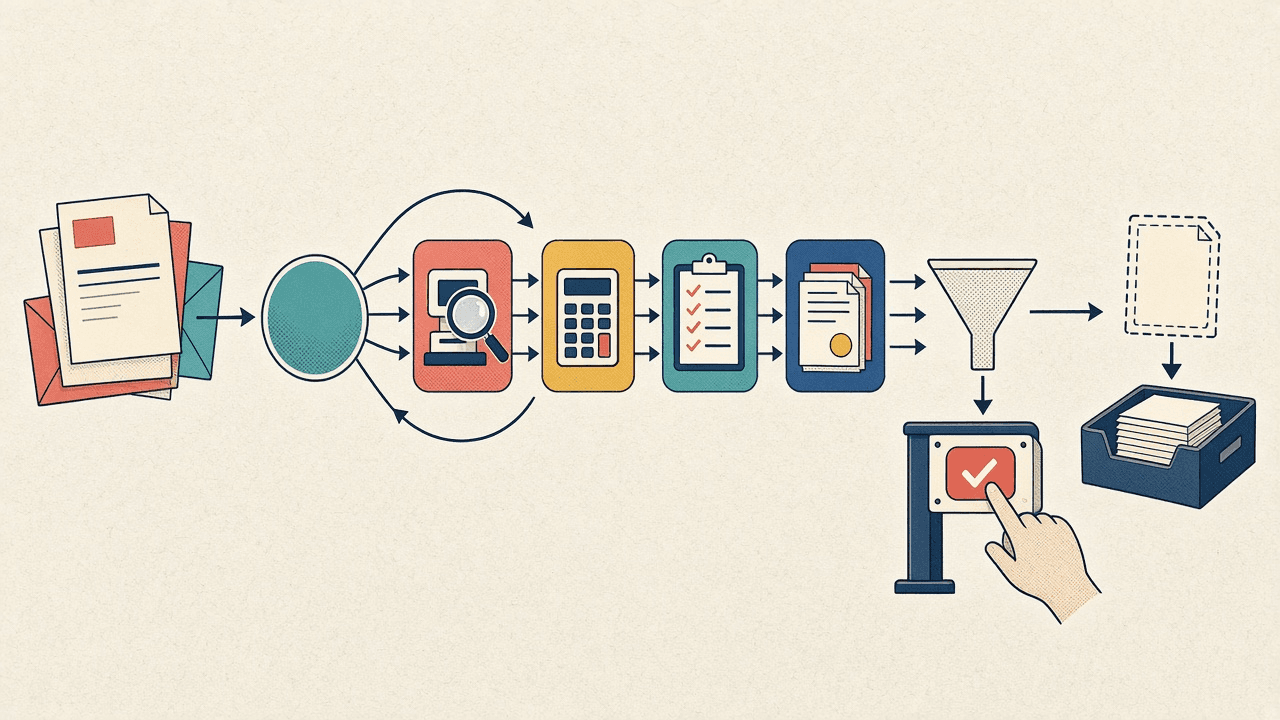
It does badly at anything where a wrong answer is expensive and hard to undo, and nobody checks. That's why every workflow we build has a code check or a human approval before money moves, a customer gets an email, or a record changes in your accounting system. Our business automation page has more on how we build these with n8n, Make and Zapier.
Mistakes we'd avoid
Starting with a chatbot. Most Parramatta firms we'd talk to have a document problem, not a conversation problem. Fix the inbox before you put a bot on the website.
Letting staff paste client files into free AI tools. It's the quickest way to create a privacy incident nobody notices for months. Pick an approved tool, set it up properly and tell people what can and can't go in.
Ignoring what your biggest client will ask. If you sell to NSW Government agencies, their buying teams work through the NSW AI Assessment Framework and buy.nsw's AI procurement guidance. Those cover human oversight, logs, audit rights and the ability to tell users they're dealing with AI. Expect those questions in a tender, and build your own automation so you can answer them honestly.
Buying a platform before mapping the process. If you can't draw the workflow on a whiteboard, software won't draw it for you.
Forgetting the privacy policy. Under the reformed Privacy Act, organisations covered by it need to explain certain automated decisions in their privacy policy from 10 December 2026. Our Privacy Act and AI guide walks through what that means.
Questions to ask any AI automation provider in Parramatta
Whoever you hire, us included, ask these before you sign:
- Where is our data processed and stored, and is that in Australia?
- Which steps can the system take without a person approving them?
- What gets logged, who can see the logs, and for how long?
- What happens when the model is wrong? Show us the check.
- Who owns the workflows and prompts if we stop working with you?
- Can you show a version that works in the languages our customers use?
- What will it cost to run each month, not just to build?
If the answers are vague, the build will be too.
FAQ
Is there demand for AI automation in Parramatta, or is it just a Sydney CBD thing?
The demand follows the economy, and Parramatta's is large: more than 34,000 registered businesses and over 193,000 local jobs on economy.id's figures. The work is different from the CBD's, with more health, government supply chains, logistics and multilingual customer service.
Do small Parramatta businesses need to worry about the Privacy Act when using AI?
Many businesses under $3 million turnover are exempt, but health service providers are covered regardless, and NSW's Health Records and Information Privacy Act adds obligations for health information. If you're unsure whether you're covered, assume you are and design for it.
What should a Parramatta business automate first?
Usually the inbox: invoices, enquiries and forms that someone currently retypes into Xero, MYOB or a CRM. It's lower risk than a customer-facing bot, and it's easy to measure the time saved.
Can AI automation handle customers who speak Mandarin, Cantonese, Korean or Hindi?
For routine enquiries, yes, reasonably well. For anything with legal, financial or clinical weight, we keep a human reviewer in the loop before it reaches the customer.
Do you need to be in Parramatta to work with us?
No. We're based in the Sydney CBD and do most discovery and build work remotely, with on-site sessions where they're useful.
Talk to us
If you run a Parramatta practice, clinic, wholesaler or professional services firm and you're not sure where AI automation fits, email us at info@ailabaustralia.com with a short description of the process that eats most of your week. We'll tell you whether it's worth automating, and if it isn't, we'll say so.
Sources
- economy.id, City of Parramatta economic profile: overview (GRP, population, local jobs, businesses), employment by industry (NIEIR 2024/25) and businesses by industry (ABS Counts of Australian Businesses 2025), checked 18 November 2026.
- Australian Bureau of Statistics, 2021 Census QuickStats: Parramatta (LGA16260), language used at home.
- NSW Government, Parramatta Square workplace hub.
- AtParramatta (City of Parramatta), Project Parramatta: tenant attraction opportunities and Westmead Health Precinct.
- Westmead Health Precinct, About Westmead.
- NSW Government, Parramatta Light Rail Stage 1 and Parramatta Light Rail opens, 20 December 2024.
- City of Parramatta, Sydney Metro West.
- OAIC, Small business and Guidance on privacy and the use of commercially available AI products.
- Information and Privacy Commission NSW, Health Records and Information Privacy Act 2002.
- Digital NSW, NSW AI Assessment Framework, and buy.nsw, AI procurement essentials (updated 6 May 2026).

WRITTEN BY
Roman Silantev
CEO and Lead AI Engineer. Scopes and builds AI systems for Australian businesses.
 ← PREVIOUSAI agent workflows with one human approval: a tested n8n build for supplier bills in Xero
 NEXT ARTICLE →Framer MCP for Australian businesses: what it can do from Claude or Cursor, and what to check before you publish