
AI FOR DENTAL PRACTICES & CLINICS
After-hours calls, recall and reactivation, unbooked treatment plans, fee and health fund questions, and review requests for Australian dental practices. Built around your practice software, the Privacy Act and Ahpra's advertising rules, with your dentists making every clinical call.
EXAMPLE ONLY · NOT A REAL PRACTICE OR PATIENT
- RECALLCheck-up overdue, 7 monthsSMS with a booking link, stops when they book… SENT ON YOUR SCHEDULE
- AFTER HOURSCaller with a chipped tooth, 9:40 pmDetails taken, on-call message sent, no advice given… ON-CALL DENTIST DECIDES
- TREATMENT PLANCrown quoted 5 weeks ago, not bookedFollow-up drafted, quote with item numbers attached… FRONT DESK APPROVES
- QUESTION"How much will my fund cover?"Explains how to check with their fund, offers the quote… RECEPTION FOR ANYTHING ELSE
NEVER DONE BY THE SYSTEM
Diagnosis, treatment advice, deciding if a dental problem can wait
the system chases · the dentist decides
001 / THE SHORT ANSWER
AI is most useful in a dental practice at the front desk and in the recall list: answering calls after hours, chasing overdue recalls, following up treatment plans that were quoted but never booked, and answering routine fee and health fund questions. It is not something to hand clinical decisions to.
Dental is different from general practice in a few ways that shape what's worth building. Much of the income depends on patients coming back for check-ups and hygiene visits, so a recall list that nobody has time to work is lost revenue. A lot of treatment is quoted before it is done, so plans sit unbooked while patients check with their health fund. And patients pay out of pocket for most of it, so the front desk spends hours on "how much will my fund cover?"
We're an AI and automation agency based in Sydney. We work remotely with practices across Australia and New Zealand and fly in for kick-offs and go-lives. Nothing on this page is clinical, legal or privacy advice. Where a rule matters, we link to the regulator's own page. For GP, specialist and allied health practices, including referrals, letters and AI scribes, see AI for medical practices.
002 / RECALL
The AI should work the list your practice software already holds, on rules your practice manager sets, and stop the moment a patient books, replies or opts out. The recall interval for each patient stays whatever the dentist set. The AI decides nothing about when someone needs to be seen.
A practical way to set it up is three groups, because each needs a different message:
- Due soon. A plain reminder that their check-up is due, with a link to book online or a reply-to-book option.
- Overdue. One or two follow-ups spaced out, then a note to reception to call if they still haven't booked.
- Lapsed. Patients not seen for 18 months or more get a single reactivation message. Anyone who doesn't respond is left alone.
Before anything is sent, patients already booked, opted out, moved away or deceased are removed. Replies the system can't handle, such as a question about a tooth, go to a reception queue.
Two rules shape the wording. Under the Spam Act 2003, commercial electronic messages need consent, must identify your practice and must have an unsubscribe that is honoured within five working days. A message that only states factual information may fall outside those rules, but adding an offer or a promotional link can change that. And Ahpra's Guidelines for advertising a regulated health service say a gift, discount or other inducement must state its terms and conditions, and advertising must not encourage unnecessary use of health services. So we keep recall messages plain: no "free whitening if you book this week".
003 / AFTER HOURS
Take the caller's details, follow the after-hours script your dentists wrote, and get the message to the right person. It should never tell a caller whether their problem can wait or what to do for it.
A broken tooth, a lost filling or pain at 9 pm is exactly the kind of call that otherwise goes to voicemail. An AI receptionist can answer every one, but the clinical decision has to stay with a dentist. The settings to agree before launch:
- Anyone describing a life-threatening emergency is told to call Triple Zero (000), every time.
- Urgent-sounding calls are sent to the on-call dentist by SMS or a call transfer, with what the caller said, so the dentist decides.
- Everything else becomes a booking request or a call-back on the morning list, flagged for reception.
- It collects what the booking needs: name, contact details, existing or new patient, and the caller's own words about the problem. Not a dental history.
- Callers are told they're speaking with an AI and, if calls are recorded, that the call is recorded.
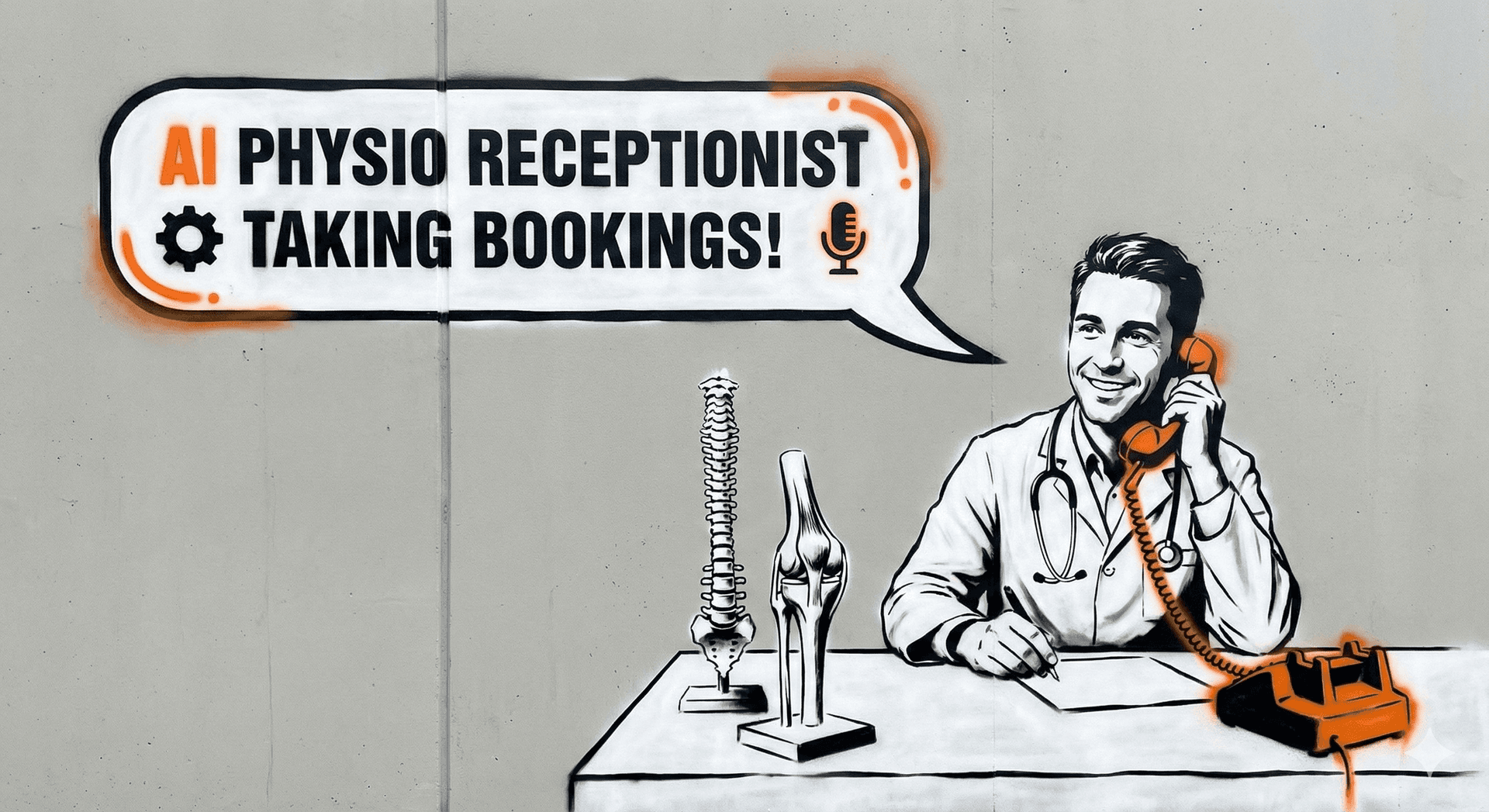
We've built this pattern for a Sydney physiotherapy clinic: a 24/7 voice receptionist that books by practitioner, collects health fund details, flags urgent-sounding calls for staff and hands complex calls to reception with the conversation so far. A dental version uses the same structure with your appointment types and your dentists' after-hours script. Our voice assistant page covers how these are built.
004 / TREATMENT PLANS
Remind patients that a plan exists and make it easy to book or ask a question. Don't try to persuade them clinically. A crown, implant or orthodontic quote that nobody follows up is often just a patient who meant to call and didn't.
A weekly treatment plan follow-up usually goes like this:
- The system lists plans that were quoted more than a set number of weeks ago and have no appointment attached.
- For each, it drafts a short message: the plan is still open, here is your written quote, reply or click to book, or ask us anything.
- The quote attached is the one the dentist already wrote, with its item numbers, so the patient can check their benefits with their fund.
- Front desk approves the batch. Any reply that asks about the treatment itself goes to the treating dentist, not the AI.
- Patients who say no, or don't respond after one follow-up, are marked and left alone.
The AI never describes consequences of delaying treatment, adds claims the dentist didn't make, or offers discounts without approved written terms. The same review-first drafting runs through our AI email automation work.
005 / FEES & FUNDS
It can answer the questions your practice already answers the same way every time, from wording you approve. It shouldn't guess what a patient's fund will pay.
Benefits depend on the patient's fund, level of cover, waiting periods and annual limits, none of which the practice controls. What the front desk can do, and what the AI can do on its behalf, is give patients what they need to ask their fund. Dental services are described using item numbers from the ADA's Australian Schedule of Dental Services and Glossary, so a written quote with item numbers is what a fund will ask for.
Answers worth loading, all written or approved by the practice:
- Which payment options you offer and whether you claim on the spot with HICAPS.
- How to request a written quote, and resending one already prepared.
- How to check benefits with a fund using the item numbers on the quote.
Anything outside that list, including questions about whether a treatment is needed, goes to reception. The same structure, a short list of approved answers and a clean hand-over, is how we build AI chatbots for practice websites.
006 / REVIEWS & AHPRA
You can ask patients for reviews, but you can't use reviews that mention clinical aspects of care to advertise your practice. Section 133 of the Health Practitioner Regulation National Law prohibits advertising that uses testimonials, and Ahpra's advertising guidelines treat a testimonial as a recommendation or positive statement about the clinical aspects of a regulated health service: symptoms, diagnosis, treatment or outcome.
In practice, that turns into a few settings for an automated review request:
- No gift, discount or prize draw for leaving a review.
- The request asks about the visit, not the result, and never suggests what to write.
- Reviews mentioning treatment or outcomes are not republished on your website, social media or ads. Comments only about customer service or communication are not treated as testimonials.
- Reviews on your own website or social pages are your responsibility. If a platform won't let you edit or remove them, the guidelines say turning the review function off may help.
- Replies to reviews on third-party sites are drafted for a person to approve, because engaging with a review can count as using it to advertise.
You aren't responsible for removing reviews on platforms you don't control. Check with your indemnity insurer or adviser before you change your marketing.
007 / WHO DOES WHAT
Recall, calls, fee questions and review requests are front-desk work. Treatment plan follow-up sits close to care. Diagnosis, treatment advice and clinical triage stay with your dentists, and we don't build software for them.
Ahpra's guidance on AI in healthcare says practitioners must apply human judgement to any output of AI, should tell patients when they use it, and must protect patient confidentiality, including checking whether patient data is used to train an AI model.
| Job | What the AI does | Who stays responsible | Watch for |
|---|---|---|---|
| FRONT DESK Recall and reactivation | Reads who is due or lapsed, sends messages on your schedule, stops when they book or opt out | Practice manager sets the rules | Spam Act for promotional messages; no inducements without terms |
| FRONT DESK After-hours calls | Answers, takes details and booking requests, sends urgent messages to the on-call dentist | On-call dentist, then reception | Never says whether a problem can wait; 000 for life-threatening emergencies |
| FRONT DESK Fee and health fund questions | Answers from your approved wording, resends the written quote with item numbers | Reception for anything outside the script | No rebate estimates; funds and cover differ |
| DENTIST CHECKS Treatment plan follow-up | Finds quoted plans not yet booked and drafts a follow-up from the plan the dentist wrote | Front desk sends; dentist answers clinical questions | No pressure, no new clinical claims, no discount offers without terms |
| FRONT DESK Review requests | Sends a short request after the visit with a link to your review page | Practice manager owns the wording | Don't reuse clinical reviews in advertising; no incentives |
| WE DON'T BUILD Diagnosis, treatment advice, clinical triage | Interprets symptoms or images, recommends treatment, ranks patients by clinical urgency | Your dentists, without our software | Clinical judgement, and possibly TGA medical device territory |
General information only. How each job is set up depends on your practice, your software and your own advice.
008 / PRACTICE SOFTWARE
Usually, but what's practical depends on what your practice management software allows, so we check it before quoting.
Dental4Windows (Centaur Software)
Centaur describes it as on-premise practice management software, with Dental4Web as its cloud option. Centaur lists eAppointments for online booking and a Connected Partner Network for linking other systems.
Core Practice
Australian cloud-based dental practice software. Its site lists 24/7 online booking, SMS and email notifications for appointment confirmations, and more than 22 integrations.
Praktika
Australian cloud-based dental software. Its site lists online booking, SMS and communication, automated recalls, quotes and treatment planning, and integrations including HICAPS and Tyro.
From each vendor's own website, November 2026. Features vary by version and plan; confirm with the vendor.
Whichever product you use, the connection falls into one of three patterns:
- Supported integration. The vendor offers a connection or partner program, and the system can read lists and write bookings directly.
- Online booking link. The AI sends patients to your existing online booking page, which writes into the appointment book itself.
- Report and confirm. A scheduled report feeds the system, and reception confirms bookings in a click.
We don't sell or resell practice software, and we're not a partner of any vendor named here.
009 / PRIVACY
Every dental practice is covered, whatever its size, and dental records are health information. The OAIC says organisations that provide a health service and hold health information are covered by the Privacy Act 1988 regardless of turnover, and lists dentists as an example. Health information is sensitive information under the Australian Privacy Principles.
If an AI tool sends patient information to a provider overseas, APP 8 can leave your practice accountable for what happens to it there. In NSW, Victoria and the ACT, private providers also follow state or territory health privacy laws. For what we build, that means agreeing before any work starts:
- Where data lives: an Australian cloud region or your own environment. See private AI hosted in Australia.
- The AI sees only what each job needs. A recall message needs a name, a due date and a phone number, not a chart.
- No patient data used to train public models, and an audit log of what was sent and who approved it.
- Documentation of what each system collects and why, so you can update your privacy policy.
The quickest risk to fix is staff pasting patient details into a free chatbot to write a letter. Give them an approved tool and a clear rule. Our AI acceptable use policy template and Privacy Act and AI guide are a starting point.
010 / HOW WE START
We start with whichever job costs the most, usually the recall list or after-hours calls, and run it alongside your current process before switching over.
- 01
Pick the job
We look at a normal month of calls, recalls or open treatment plans with your practice manager.
- 02
Check the software
We confirm what your practice software allows: integration, online booking link, or report and confirm.
- 03
Write the rules
Message wording, the after-hours script, stop rules, where data lives and who approves what, agreed before the build.
- 04
Run it in parallel
The system drafts and the team checks its work on real patients before anything is sent automatically.
- 05
Switch over and review
Go live once your team is happy, with the log on from day one and a review after the first month.
011 / BUILT AND RUNNING
012 / QUESTIONS
Anything else is quicker to answer on a call. Thirty minutes, free, with the people who would build it.
Mostly at the front desk and in the recall list. Useful jobs include answering calls after hours and taking booking requests, sending recall and reactivation messages, following up treatment plans that were quoted but never booked, answering routine questions about fees, health funds and payment options from your own approved answers, and sending review requests. Diagnosis, treatment advice and deciding how urgent a dental problem is stay with your dentists.
Tell us where your front desk loses the most time. In thirty minutes we'll sketch the workflow, what your practice software allows and who approves each message.
Book a free call→