FREE TOOLS · CURATED LIST · CHECKED 27 NOVEMBER 2026

Ten open source frameworks and SDKs for building AI agents in code, each checked on GitHub for licence, languages, model support, MCP, production features and the catches. Plus LangGraph vs CrewAI, and what happened to AutoGen.

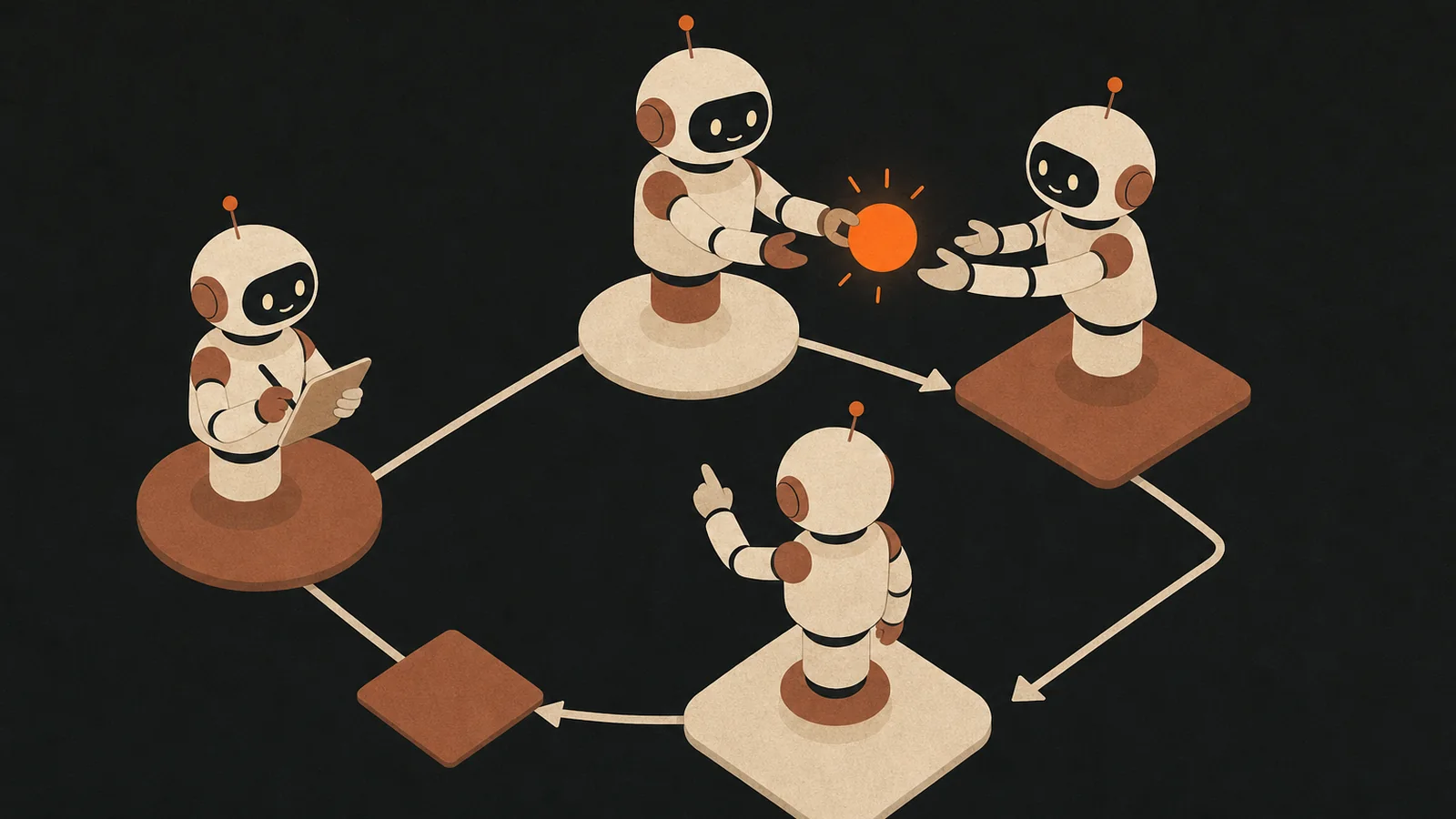
Illustration of four cream robots on platforms joined by arrows in a loop, one writing on a clipboard and two passing a glowing orange ball: AI agents handing work to each other

001 / THE SHORT ANSWER

WHAT AN AGENT FRAMEWORK HANDLESIN YOUR CODE
  • MODELThe LLM that decidescloud API or a local runner
  • TOOLSFunctions and MCP serverswhat the agent is allowed to do
  • LOOPThink, call a tool, read, repeatthe part every framework gives you
  • STATEMemory and checkpointsresume after a crash or a wait
  • HUMANApproval before it actspause, review, continue
  • TRACEEvery step recordedso you can debug and evaluate

For most Python teams, LangGraph; for a fast multi-agent prototype, CrewAI; for TypeScript, Mastra; for Microsoft and .NET shops, Microsoft Agent Framework. If nobody on the team writes code, you don't want a framework at all: a workflow tool like n8n will get a business agent live sooner and be easier to look after.

An agent framework is a code library that runs the loop behind an AI agent: the model decides on a step, calls a tool, reads the result and decides again until the job is done. Every framework on this list does that part well. They differ in everything around it:

  • ✓State and recovery: can a run pause for days waiting for approval, or survive a server restart, and carry on where it stopped?
  • ✓Control: do you spell out every step (a graph or workflow), or let the model decide more of the path (roles and handoffs)?
  • ✓Tools: all ten now use MCP (Model Context Protocol) servers, so the same tool servers work across frameworks. Our list of MCP servers for business covers what to connect.
  • ✓Tracing and evaluation: can you see why the agent did what it did, and test changes against a fixed set of cases before they go live?

002 / THE LIST

These ten held up when we checked each repository on 27 November 2026: actively developed, a permissive licence (MIT or Apache 2.0) for the core, and able to use more than one model provider. They are grouped by the kind of agent they are best at, not ranked, because the right one depends on your team's language and how much control the job needs.

ORCHESTRATION

Graph and multi-agent orchestration

For agents that run for a while, branch, wait for a person and must pick up where they left off. More structure, more to learn.

01LangGraph

MIT

A low-level framework from the LangChain team for building agents as graphs: you define the steps (nodes), the paths between them (edges) and the state that flows through. Its README leads with durable execution, human-in-the-loop and memory.

LANGUAGES
Python, JavaScript/TypeScript
BEST FOR
Agents with real business logic: several steps, branches, approvals, and runs that must survive a crash or wait days for a person.
MODEL-AGNOSTIC?
Yes. Uses LangChain's model integrations, so OpenAI, Anthropic, Google, Azure, Bedrock and local models via Ollama all plug in.
MCP SUPPORT
Yes, through LangChain's MCP support (langchain[mcp]). The older langchain-mcp-adapters repo is archived and points there.
PRODUCTION FEATURES
Checkpointing and durable execution, interrupts for human approval, short- and long-term memory. Tracing and evaluation through LangSmith.
LEARNING CURVE
Steep
CAVEATS
You design the graph yourself, which is more code than a role-based framework. LangSmith (tracing, deployment) is a separate commercial product; LangGraph runs without it, but you then need your own tracing.

02CrewAI

MIT

A standalone Python framework (not built on LangChain) where you describe a 'crew' of agents with roles, goals and tasks, plus 'Flows' for deterministic, event-driven steps around them.

LANGUAGES
Python
BEST FOR
Teams that think in roles (researcher, writer, reviewer) and want a working multi-agent prototype fast, then tighten it with Flows.
MODEL-AGNOSTIC?
Yes. Defaults to the OpenAI API; its README says other providers and local models through Ollama or LM Studio are supported.
MCP SUPPORT
Yes. The README lists MCP and A2A support for agents.
PRODUCTION FEATURES
Memory, knowledge sources, checkpointing, human input, structured outputs and guardrails. The commercial CrewAI AMP adds managed deployment and observability.
LEARNING CURVE
Gentle
CAVEATS
Role-play prompting is easy to start and harder to make predictable; move fixed steps into Flows and code. Collects anonymous usage telemetry by default (its README says prompts and task content are not included unless you opt in).

03Microsoft Agent Framework

MIT

Microsoft's successor to both AutoGen and Semantic Kernel, built by the same teams. Agents that call tools and MCP servers, plus graph-based workflows for explicit multi-agent orchestration, with Semantic Kernel's enterprise features (sessions, middleware, telemetry).

Note: We link Microsoft's documentation here because, when we checked, the main repository (github.com/microsoft/agent-framework) returned 'not found' on GitHub, although Microsoft's docs, the AutoGen and Semantic Kernel READMEs and PyPI all point to it. The licence shown here is from the PyPI package (MIT, 'Production/Stable') and the Go repository (MIT on GitHub). Check the repo is back before you rely on it.

LANGUAGES
Python, .NET (C#); Go in public preview
BEST FOR
Microsoft and Azure shops, especially .NET teams, and anyone migrating off AutoGen or Semantic Kernel.
MODEL-AGNOSTIC?
Yes. Docs list Microsoft Foundry, Azure OpenAI, OpenAI, Anthropic, Ollama and more.
MCP SUPPORT
Yes. MCP clients for tools are a core building block, and Microsoft highlights A2A and MCP interoperability.
PRODUCTION FEATURES
Workflows with state management for long-running and human-in-the-loop runs, middleware, context providers for memory, telemetry.
LEARNING CURVE
Moderate
CAVEATS
Microsoft's own docs say you're responsible for data that flows to third-party (non-Azure) models and services. Python, .NET and Go don't have identical features yet; check the docs for your language.

04Mastra

Apache-2.0 + Enterprise (GitHub: NOASSERTION)

A TypeScript framework for agents and workflows that slots into Next.js, React or Node apps, with model routing, memory, RAG, evals and observability in one package.

Note: Everything outside directories named ee/ is Apache 2.0. Code under ee/ is source-available under the Mastra Enterprise License: you may read and test it, but production use needs a paid licence key. Stay on the Apache 2.0 parts if you want it free.

LANGUAGES
TypeScript
BEST FOR
JavaScript and TypeScript teams building agents into a web app or Node backend.
MODEL-AGNOSTIC?
Yes. Its README describes one interface over 40+ providers, including OpenAI, Anthropic and Gemini.
MCP SUPPORT
Yes, both directions: an MCP client (@mastra/mcp) and authoring your own MCP servers.
PRODUCTION FEATURES
Workflow suspend and resume for human approval (state kept in storage), conversation memory, built-in evals and observability.
LEARNING CURVE
Moderate
CAVEATS
Watch the ee/ boundary when you add features such as auth. Needs a recent Node.js (the core package requires Node 22.13 or later). Releases ship very often; pin versions.

AGENT SDKS

Lightweight agent SDKs

An agent loop, tools, structured output and tracing with little ceremony. Quickest from idea to a working agent in code.

05OpenAI Agents SDK

MIT

A lightweight SDK for agents, handoffs between agents, guardrails and sessions, from OpenAI. Small set of concepts and good docs.

LANGUAGES
Python, JavaScript/TypeScript
BEST FOR
Teams already on the OpenAI API who want a clean agent loop with tracing, handoffs and voice agents.
MODEL-AGNOSTIC?
Yes, despite the name. Its README says it supports the OpenAI Responses and Chat Completions APIs and 100+ other LLMs.
MCP SUPPORT
Yes. MCP is one of its built-in tool types, alongside function tools and OpenAI's hosted tools.
PRODUCTION FEATURES
Built-in tracing, human-in-the-loop, sessions for conversation history, input and output guardrails.
LEARNING CURVE
Gentle
CAVEATS
Tracing is on by default and sends traces to OpenAI's backend; turn it off with OPENAI_AGENTS_DISABLE_TRACING=1 or send traces elsewhere. Its docs say tracing isn't available under OpenAI Zero Data Retention. Still on 0.x versions, so pin them.

06Pydantic AI

MIT

An agent framework from the team behind Pydantic, the validation library most Python AI tools already use. Typed end to end: tools, dependencies and outputs are checked like any other Python code.

LANGUAGES
Python
BEST FOR
Python teams who want agents to feel like normal, testable, type-checked code, with validated structured output.
MODEL-AGNOSTIC?
Yes. Switching provider is a model-string change.
MCP SUPPORT
Yes. MCP servers attach to an agent as a capability.
PRODUCTION FEATURES
Durable execution on engines including Temporal, DBOS and Prefect; step persistence to save and resume runs; production docs covering human approval, cost limits and tracing. Tracing via Pydantic Logfire or other OpenTelemetry tools.
LEARNING CURVE
Moderate
CAVEATS
Multi-agent orchestration is something you compose yourself rather than a built-in 'crew'. Logfire is a separate commercial service; you don't need it.

07Google Agent Development Kit (ADK)

Apache-2.0

Google's code-first toolkit for building, evaluating and deploying agents and multi-agent systems, with a built-in development UI for testing and debugging.

LANGUAGES
Python, TypeScript, Java, Go
BEST FOR
Google Cloud and Gemini users, and Java or Go teams who have fewer options elsewhere.
MODEL-AGNOSTIC?
Yes. Its README says it's optimised for Gemini but model-agnostic and deployment-agnostic.
MCP SUPPORT
Yes. Agents can use MCP tools, OpenAPI specs and existing tools.
PRODUCTION FEATURES
Workflows with human-in-the-loop, an evaluation CLI (adk eval), a dev UI, and one-command deployment to Google Cloud Run.
LEARNING CURVE
Moderate
CAVEATS
The smoothest deployment paths lead to Google Cloud. The four language versions are separate repos and don't move in lockstep.

08smolagents

Apache-2.0

A deliberately small agent library from Hugging Face. Its CodeAgent writes its actions as Python code instead of JSON tool calls, which often takes fewer steps.

LANGUAGES
Python
BEST FOR
Experiments, research and data-analysis agents, especially with open models from the Hugging Face Hub.
MODEL-AGNOSTIC?
Yes. Local transformers or Ollama models, Hub inference providers, OpenAI, Anthropic and others.
MCP SUPPORT
Yes. Tools can be loaded from any MCP server.
PRODUCTION FEATURES
Memory of steps and logs; little else built in. You add tracing, persistence and approvals yourself.
LEARNING CURVE
Gentle
CAVEATS
Code-writing agents execute code. Its README says to run agent code in a sandbox (E2B, Modal, Docker and others). Release pace has slowed (latest release May 2026), though the repo still gets commits.

DOCUMENT-HEAVY

Retrieval-first frameworks

Started as RAG toolkits and grew agents. Pick these when the hard part is finding and reading the right documents.

09LlamaIndex (Agent Workflows)

MIT

A long-standing framework for connecting LLMs to your data, with event-driven Agent Workflows (async steps that emit and consume events) now in the separate llama-agents repo.

LANGUAGES
Python
BEST FOR
Document workflows: extraction, classification and question answering over contracts, invoices and reports, with a person reviewing.
MODEL-AGNOSTIC?
Yes. Large set of model and vector-store integrations.
MCP SUPPORT
Yes, through the llama-index-tools-mcp integration.
PRODUCTION FEATURES
llama-agents-server wraps a workflow as a REST API with streaming, persistence and human-in-the-loop support.
LEARNING CURVE
Moderate
CAVEATS
Its README says the company's main focus has shifted to its commercial LlamaParse service; the open source framework remains available. Weigh that before a long-term bet.

10Haystack

Apache-2.0

deepset's orchestration framework for pipelines and agents with explicit control over retrieval, routing, memory and generation. A mature choice for search and RAG that now includes an Agent component.

LANGUAGES
Python
BEST FOR
Retrieval-heavy agents where you want every step of how context reaches the model to be visible and testable.
MODEL-AGNOSTIC?
Yes. Its README describes it as model- and vendor-agnostic; integrations include Anthropic and Ollama.
MCP SUPPORT
Yes. An MCP integration for tools, and Hayhooks can serve pipelines and agents as MCP servers or REST APIs.
PRODUCTION FEATURES
Tracing and evaluation modules, agent lifecycle hooks (such as before_tool) for guardrails, token and tool-call tracking.
LEARNING CURVE
Moderate
CAVEATS
Pipeline-first thinking takes some getting used to if you only want a chat agent. Collects anonymous component-usage telemetry by default; its docs explain how to opt out.

Checked: 27 November 2026, on each project's GitHub repository (licence file, archive status, releases, recent commits, README) and its official docs. These projects ship new versions weekly or faster; read the current README and licence before you build.

003 / SIDE BY SIDE

All ten can use tools from MCP servers and more than one model provider, so those no longer separate them. What does: the language your team writes, how the framework wants you to model the work (a graph, a crew, a typed loop, a pipeline), and what you have to add yourself before it's safe in production.

Open source AI agent frameworks compared by language, licence, style, learning curve and main catch (checked 27 November 2026)
FrameworkLanguagesLicenceStyleMCPLearning curveMain catch
LangGraphPy, JS/TSMITGraph of steps and stateYesSteepMost code to write; LangSmith is commercial
CrewAIPyMITRoles, tasks, FlowsYesGentleHarder to make predictable; telemetry on
Microsoft Agent FrameworkPy, .NET, Go (preview)MITAgents + graph workflowsYesModerateMain repo unreachable when checked
MastraTSApache-2.0 + EnterpriseAgents + workflows in your appYesModerateee/ code needs a paid key
OpenAI Agents SDKPy, JS/TSMITAgents with handoffsYesGentleTraces go to OpenAI by default
Pydantic AIPyMITTyped agent loopYesModerateMulti-agent is DIY
Google ADKPy, TS, Java, GoApache-2.0Agents + dev UI + evalsYesModerateEasiest on Google Cloud
smolagentsPyApache-2.0Agents that write codeYesGentleNeeds a sandbox
LlamaIndexPyMITEvent-driven workflowsYesModerateVendor focus moved to LlamaParse
HaystackPyApache-2.0Pipelines + agent componentYesModeratePipeline mindset; telemetry on

004 / THE MOST ASKED COMPARISON

Choose LangGraph when the agent touches money, customers or records and you need to say exactly what happens at each step. Choose CrewAI when the job splits naturally into roles and you want to see it working this week. Many teams prototype in CrewAI and rebuild the parts that matter as explicit steps, in CrewAI Flows or in LangGraph.

We have built on LangGraph ourselves: our property feasibility platform uses it to capture a deal brief, call calculation tools and explain results, with LangSmith for tracing and evaluation and a separate Python engine doing every calculation. That split, where the agent talks and tested code does the maths, matters more than which framework you pick.

LangGraph compared with CrewAI (checked 27 November 2026)
QuestionLangGraphCrewAI
How you model the workA graph: nodes, edges and shared state you defineA crew: agents with roles and goals, tasks, plus Flows
LanguagesPython and JavaScript/TypeScriptPython
Control vs speedFull control over every step; more codeWorking prototype quickly; less fine control
Pause for a personInterrupts: inspect and edit state, then resumeHuman input on tasks; checkpointing
Survive a crashDurable execution from checkpointsCheckpointing
TracingLangSmith (commercial) or your own tracing toolsCrewAI's Crew Control Plane (part of commercial AMP; a free tier exists) or your own tools
LicenceMITMIT

005 / WHICH ONE SHOULD YOU PICK

Start from who will maintain it. A framework your team can't read is a liability the day the person who built it leaves; the language and skills you already have narrow the list to two or three.

IF: NOBODY ON THE TEAM WRITES CODE

Don't use a framework: use n8n

A visual workflow tool with an AI Agent node covers most small-business agents (enquiries, inboxes, CRM updates). Our n8n agent tutorial builds one step by step, and the self-hosted automation tools list covers n8n's Sustainable Use License and the alternatives.

IF: A PYTHON TEAM, SERIOUS WORKFLOW

LangGraph, or Pydantic AI for a typed, lighter start

LangGraph when you need checkpoints, branches and approvals mid-run. Pydantic AI when you want agents that read like ordinary tested Python, and add durable execution through Temporal or DBOS later if you need it.

IF: A TYPESCRIPT OR NEXT.JS TEAM

Mastra, or the OpenAI Agents SDK for JS

Mastra gives you workflows, memory, evals and MCP in one TypeScript package; stay on its Apache 2.0 parts. The OpenAI Agents SDK is smaller and works with other providers too. LangGraph.js is the option if you want the graph model.

IF: A MICROSOFT OR .NET SHOP

Microsoft Agent Framework

It replaces both AutoGen and Semantic Kernel and has first-class .NET support. If the agent should live inside Teams and Microsoft 365 with no custom code, look at Copilot Studio first.

IF: GOOGLE CLOUD, OR JAVA AND GO

Google ADK

The only framework here with official Python, TypeScript, Java and Go versions, a built-in dev UI and an evaluation command. Model-agnostic, but most at home with Gemini on Google Cloud.

IF: THE HARD PART IS THE DOCUMENTS

LlamaIndex Workflows or Haystack

When answers depend on finding the right clause in the right PDF, start from a retrieval-first framework. Haystack if you want every pipeline step explicit; LlamaIndex for document extraction workflows with human review.

006 / PRODUCTION

It doesn't decide what the agent is allowed to do, test whether it does it well, or keep personal information where it belongs. Those are design decisions, and they matter more than the choice between two good frameworks.

  • ✓Least-privilege tools. Give each agent only the tools its job needs, read-only where possible, and put an approval step in front of anything that sends, pays, deletes or changes a customer record.
  • ✓Treat inputs as data, not instructions. Emails, web pages and documents the agent reads can carry prompt injection. Limit what a single compromised step can do, and check outputs with code before they act.
  • ✓Deterministic work in code. Prices, tax, dates and totals come from tested functions the agent calls, not from the model.
  • ✓Evaluation before every change. A fixed set of real cases (with personal details removed) and expected answers, run whenever you change the prompt, model or framework version. Our LLM evaluation tools guide compares the options.
  • ✓Know where traces go. Several defaults send traces to a hosted service (the OpenAI Agents SDK sends them to OpenAI unless you turn tracing off). Traces include prompts and tool results, so if they hold personal information and leave Australia, Australian Privacy Principle 8 applies. Self-host tracing or choose a provider that fits your data rules.
  • ✓Pin versions. Most of these projects ship releases weekly; several are still on 0.x versions. Upgrade on purpose, after the evaluation set passes.

007 / LEFT OUT

AutoGen is archived, Semantic Kernel has been superseded, and the Claude Agent SDK isn't fully open source. All three are well known, which is why they're worth explaining rather than quietly dropping.

  • ✓Microsoft AutoGen (github.com/microsoft/autogen; code MIT, docs CC-BY-4.0): archived on GitHub. Its README says Microsoft provides no bug fixes, security fixes, features or support, and advises against production use. Microsoft points new users to Agent Framework and publishes a migration guide.
  • ✓Semantic Kernel (github.com/microsoft/semantic-kernel, MIT): still receiving releases, but its README now opens with "Semantic Kernel is now Microsoft Agent Framework". Fine to maintain; start new work on Agent Framework.
  • ✓Claude Agent SDK (github.com/anthropics/claude-agent-sdk-python, MIT; github.com/anthropics/claude-agent-sdk-typescript): the Python wrapper is MIT, but it runs the bundled Claude Code CLI, and the TypeScript repo's licence says all rights reserved, subject to Anthropic's Commercial Terms. Built for Claude models. A strong choice if you've settled on Claude (see Claude for business), but not an open source, model-agnostic framework.
  • ✓DSPy (github.com/stanfordnlp/dspy, MIT): excellent, and it has ReAct agents and MCP tools, but its real job is programming and optimising prompts and model calls. Use it alongside an agent framework rather than as one.

008 / WHERE WE CAN HELP

When the agent will write to your systems, handle client or personal information, or needs to keep working after the person who built it moves on. A developer trying CrewAI or Pydantic AI over a weekend doesn't need a consultant; an agent that drafts replies to customers or updates your CRM needs someone to own its limits, testing and monitoring.

We're a Sydney team working remotely across Australia and New Zealand. Our AI agent development work picks the framework from your team's skills and data rules (n8n, custom code or Copilot Studio), and agentic workflows covers multi-step processes with people approving the steps that matter. If the models must stay onshore, see private AI in Australia; if you're building on OpenAI's models, see OpenAI API integration. Every build is scoped and priced in writing.

009 / QUESTIONS

Anything else is quicker to answer on a call. Thirty minutes, free, with the people who would build it.

There isn't one winner; it depends on your team's language and how much control you need. For Python teams building agents with approvals and long-running steps, LangGraph is the most proven choice. For a quick multi-agent prototype, CrewAI. For TypeScript apps, Mastra or the OpenAI Agents SDK for JavaScript. For Microsoft and .NET shops, Microsoft Agent Framework. If nobody on the team writes code, use a workflow tool such as n8n instead of a framework.

Tell us what the agent should do, what it can touch and who will look after it. In thirty minutes we'll suggest a framework from this list, or tell you honestly if n8n or a plain API call is the better fit.

Book a free call→