
App legal checklist for Australia: what Claude can fix, and what it cannot

On this page · 7 sections
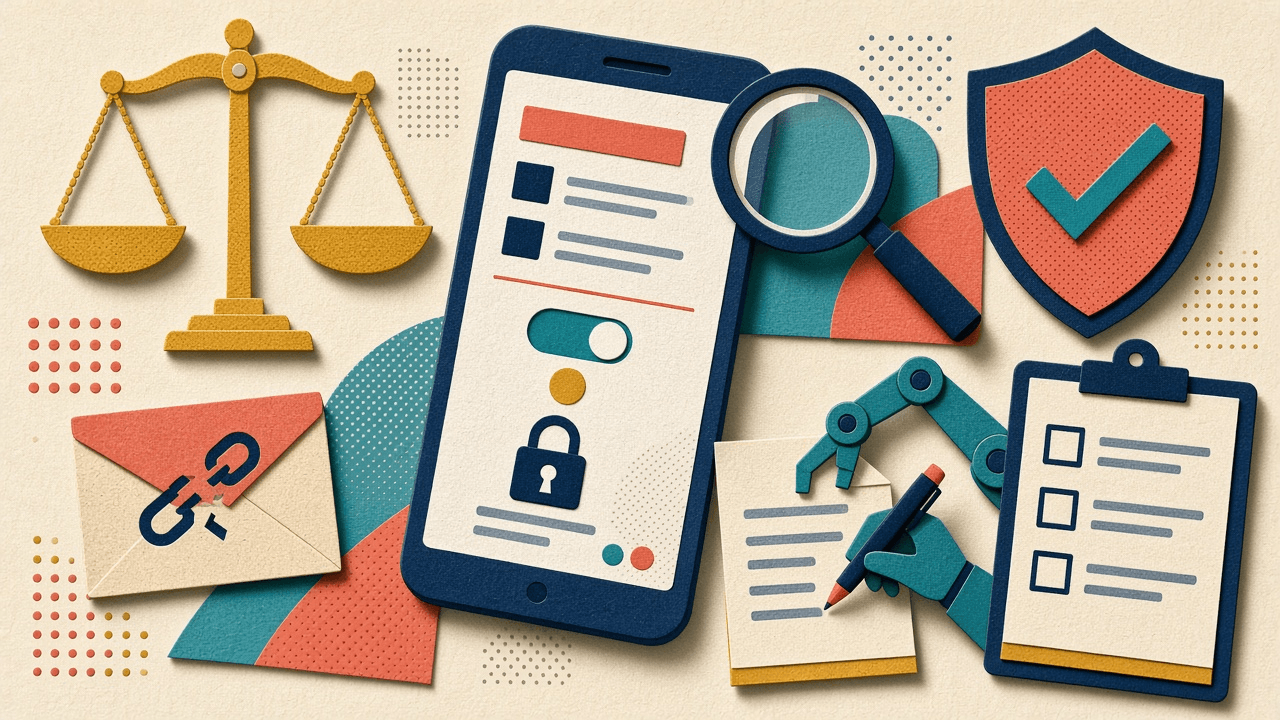
A short TikTok from @millee.md lists 20 things to have Claude do so your app doesn't get sued. It's a good list, and a generic one. Some items carry real legal weight in Australia, a couple matter less here than the clip implies, and one big change lands on 10 December 2026. Here's our read, and an honest line on what an AI coding tool can and cannot do.
We're AI Lab Australia, a Sydney AI agency. We work as forward-deployed engineers: we sit inside your team and ship the app, not a slide deck. We like this list because it treats compliance as engineering work, which most of it is. Our pushback is narrower. Claude can write a privacy policy in thirty seconds, but it has no idea where your data actually goes, and that gap is where businesses get hurt.
This is general information, not legal advice. If your app handles health, financial or children's data, talk to a lawyer before launch.
The 20 items, grouped by the Australian law behind them
The list is @millee.md's. The regrouping and the Australian commentary are ours.
1. Privacy: policy, collection, notice, SDKs, deletion (items 1, 6, 7, 8, 20)
The Privacy Act 1988 is the core law, and its 13 Australian Privacy Principles (APPs) are the rules you build against.
Who is covered. The Office of the Australian Information Commissioner (OAIC) says the Privacy Act covers organisations with annual turnover above $3 million. Smaller businesses are still covered if they are, among other things, a private health service provider (which includes gyms and allied health), a business that sells or buys personal information, or a contracted service provider to an Australian Government contract. Check that list before you lean on the small business exemption.
Privacy policy (item 1). APP 1.3 requires a "clearly expressed and up to date" policy. APP 1.4 lists what goes in it: what you collect and why, how people access and correct it, how to complain, and whether data is likely to go overseas, and where.
The 10 December 2026 change. The OAIC confirms that from 10 December 2026, if a computer program makes, or substantially and directly helps make, decisions that could significantly affect someone's rights or interests using their personal information, your privacy policy must describe the kinds of information and decisions involved (APP 1.7 and 1.8). If your app scores, approves or declines people, that's you. Our Privacy Act and AI guide goes deeper.
Collect less, and say so (items 6 and 7). APP 3.2 says an organisation must not collect personal information unless it is "reasonably necessary" for its functions or activities. APP 5 requires reasonable steps to tell people about the collection at or before the time, or as soon as practicable after. So cut unused fields and put a short collection notice beside each form.
Third-party SDKs (item 8). A software development kit (SDK) is another company's code inside your app: analytics, crash reporting, ads, chat widgets. The OAIC's tracking pixels guidance is written about pixels, but in our reading it applies just as well to SDKs that do the same job. It puts responsibility on the business deploying the tool, warns against "set and forget", says sensitive information generally must not flow to third-party platforms, and notes APP 8 applies if the provider sends data overseas. We'd put this item first.
Data deletion (item 20). We found no general right to erasure in the APPs of the kind people know from Europe's General Data Protection Regulation (GDPR). What exists is APP 11.2: once you no longer need personal information for a permitted purpose, take reasonable steps to destroy or de-identify it, unless a law requires you to keep it. People can also request access (APP 12) and correction (APP 13). Build a deletion and export path anyway; it covers APP 11.2 and users expect it.
Exempt businesses should also know the statutory tort for serious invasions of privacy started on 10 June 2025 and, per the OAIC, can reach entities that aren't APP entities. The bar is high, but the exemption isn't a free pass.
2. Consumer law: terms, refunds, fees, dark patterns, reviews, claims (items 2, 3, 9, 10, 11, 12)
The Australian Consumer Law (ACL), enforced by the Australian Competition and Consumer Commission (ACCC), applies whatever your turnover.
Terms and refund policy (items 2 and 3). This is where US templates get Australian businesses into trouble. The ACCC says consumer guarantees can't be taken away by anything a business says, including "no refunds" or a refund window that expires after a set number of days, or a claim that you aren't responsible for problems. Misleading people about these rights is against the law. Your policy can add to the guarantees, never subtract. If Claude writes "all sales are final", delete it.
Hidden fees (item 10). The ACCC's price display rules already require the total price as a single figure, including unavoidable fees, at least as prominent as any part price.
Dark patterns (item 9). These are designs that nudge people into choices they wouldn't otherwise make: pre-ticked add-ons, fake countdowns, a cancel button four screens deep. The Competition and Consumer Amendment (Unfair Trading Practices) Act 2026 received assent on 6 July 2026 and commences on 1 July 2027. It bans conduct that manipulates consumers, or unreasonably distorts the environment they decide in, and causes or is likely to cause them detriment. It also adds rules for per-transaction charges and subscriptions, including easy cancellation. Passed, not yet in force. Design that misleads can already breach the ACL, so fix it now.
Fake reviews (item 11). The ACCC says it's against the law to create fake or misleading reviews or arrange for others to, review incentives must apply to positive and negative reviews alike and be disclosed, and removing genuine negative reviews can also mislead. Make sure no placeholder testimonials ship.
Unsupported claims (item 12). Claims must be true, accurate and based on reasonable grounds, and intent doesn't matter. "Bank-grade security" and "saves you 10 hours a week" are claims. AI-written landing pages are full of them, so read every line before launch.
3. Accessibility (items 13, 14, 15)
The Disability Discrimination Act 1992 (DDA) makes disability discrimination unlawful in areas of public life. The Australian Human Rights Commission's guidelines on equal access to digital goods and services cover websites and apps, point to the Web Content Accessibility Guidelines (WCAG) as the applicable standard, and say to meet the latest published version. The guidelines themselves are not legally binding. The DDA is.
The three items map to WCAG success criteria:
- Alt text (item 13) is WCAG 1.1.1 Non-text Content: non-text content needs a text alternative that serves the same purpose.
- Colour contrast (item 14) is WCAG 1.4.3: at least 4.5:1 for normal text and 3:1 for large text.
- Keyboard navigation (item 15) is WCAG 2.1.1 Keyboard: all functionality operable through a keyboard.
Claude is genuinely good at this. It can audit components, compute contrast ratios and fix focus order quickly. It can't tell you whether a screen reader user can finish your checkout. Test that yourself.
4. Marketing email (item 18)
The Spam Act 2003 is separate from the Privacy Act, so the small business exemption doesn't apply. The Australian Communications and Media Authority (ACMA) says commercial messages need consent, must identify the sender with contact details, and must include an unsubscribe option that is honoured within 5 working days, works for at least 30 days, costs nothing and needs no login. You must be able to prove consent, so log who agreed, when and how. Test the unsubscribe link; don't trust the template.
5. Children (item 17)
The 2024 amendments require the OAIC to make a Children's Online Privacy Code, which must be registered by 10 December 2026 and will bind APP entities running online services likely to be accessed by children. At the OAIC's last update it was still being finalised. If kids could plausibly use your app, design for them now and check the final code once registered.
6. Business details, cookies and licences (items 4, 5, 16, 19)
Business details (item 16). We found no general rule that a website must show an Australian Business Number (ABN). Tax invoices must carry it (business.gov.au), and ASIC requires companies to show their name and Australian Company Number (ACN), or ABN, on documents such as invoices, receipts and orders. Put your legal name and ABN in the footer anyway. It's cheap trust.
Cookie policy and banner (items 4 and 5). We found no Australian law specifically requiring a cookie consent banner. Where cookies or pixels collect personal information, the Privacy Act applies: the OAIC's APP 3 guidelines name online cookies as a means of collection. Disclose your trackers properly. If you actively serve people in the European Union, their rules may apply, and that's a question for someone who knows them.
Fonts and images (item 19). Using copyright material without permission, outside an exception, is generally infringement (Attorney-General's Department). AI tools happily pull in a font or placeholder photo without checking its licence. Keep a register of every asset and its licence.
What Claude can and cannot do here
It can: draft a privacy policy, terms and collection notices; question every form field; list the SDKs in your package files; wire up unsubscribe and account deletion; fix contrast, alt text and keyboard traps; flag "no refunds" wording and unprovable claims.
It cannot: know where your data goes once it leaves your code, what your vendors do with it, whether you're under the $3 million threshold or caught by an exception, or whether a decision your app makes "significantly affects" someone. A privacy policy describing the app you wish you'd built is worse than none. It's a misleading statement with your name on it.
Our view: let Claude do the drafting and wiring, and spend the saved hours on the data map. That's where the real risk lives, and it's what we do first on every engagement. Secure by default means knowing your data flows before you write the policy.
Copy this prompt into Claude
Audit this codebase for an Australian app. List every place personal information is collected (forms, analytics, SDKs, logs), what is collected, and where it is sent, including overseas. Flag unnecessary fields, wording that limits refunds, prices shown without unavoidable fees, pre-ticked boxes and claims that need evidence. Check alt text, 4.5:1 contrast, keyboard access, and that marketing emails identify the sender and unsubscribe works. Don't write any policy yet. Mark anything you're unsure about.
Take the list to whoever owns legal sign-off. Our post on Claude Code skill packs shows how to save a checklist like this as a reusable skill.
The checklist, grouped
Privacy (check whether you're covered first)
- APP 1.4 privacy policy, plus automated decision wording by 10 December 2026 if APP 1.7 applies
- Collection notice at each form; every field justified
- SDK and pixel inventory: what each collects and which countries it goes to
- Destroy or de-identify data you no longer need; handle access and correction requests
Consumer law (everyone)
- Refund terms that never exclude consumer guarantees
- Single, prominent total price
- No fake reviews; incentives disclosed; every claim backed by evidence
- Dark patterns gone before 1 July 2027
Accessibility and email
- Alt text, 4.5:1 contrast, full keyboard use, screen reader test
- Recorded consent, sender identified, unsubscribe honoured within 5 working days
Everything else
- Legal name and ABN visible; ACN or ABN on invoices and receipts
- Licence register for fonts and images
- Children's design check, then the final code once registered
FAQ
Does my small app need a privacy policy in Australia?
If the Privacy Act covers you, yes. It covers organisations with turnover above $3 million and some smaller ones, including health service providers and businesses that buy or sell personal information. Even if you're exempt, a clear policy is good practice and users expect it.
Can a refund policy say "no refunds" in Australia?
No. The ACCC says consumer guarantees can't be taken away by a "no refunds" sign or a time limit, and misleading people about those rights is against the law.
What changes on 10 December 2026?
If a computer program makes or substantially helps make decisions that could significantly affect people, using their personal information, your privacy policy must describe the kinds of information and decisions involved. The Children's Online Privacy Code is also due to be registered by that date.
Can Claude make my app legally compliant?
It can draft documents and fix code fast. It can't know your real data flows, vendor contracts or whether an exemption applies to you. Treat its output as a first draft for a person to verify.
Want a second set of eyes before launch?
We run this audit for Australian businesses: data map first, then the code fixes and the policies that match. See our AI consulting and custom web development work, or get in touch with a link to your app.
Sources
- @millee.md, TikTok: things to have Claude do so your app doesn't get sued, viewed 17 November 2026.
- OAIC, Rights and responsibilities, Read the Australian Privacy Principles, New resources on transparency for AI and automated decision-making, Statutory tort, Tracking pixels guidance, APP 3 guidelines and Children's Online Privacy Code, checked 17 November 2026.
- ACCC, Consumer rights and guarantees, Price displays, Online reviews and False or misleading claims, checked 17 November 2026.
- Federal Register of Legislation, Competition and Consumer Amendment (Unfair Trading Practices) Act 2026, checked 17 November 2026.
- ACMA, Avoid sending spam, checked 17 November 2026.
- Australian Human Rights Commission, Guidelines on equal access to digital goods and services, checked 17 November 2026.
- W3C, WCAG 2.2 and Understanding SC 1.4.3, checked 17 November 2026.
- business.gov.au, How to invoice; ASIC, Australian Company Number; Attorney-General's Department, Copyright basics, checked 17 November 2026.

WRITTEN BY
Roman Silantev
CEO and Lead AI Engineer. Scopes and builds AI systems for Australian businesses.
 ← PREVIOUSClaude cannot hear your edit. Here is what Openverse, Earshot and Real SFX actually do
 NEXT ARTICLE →How to use Claude for business in Australia: which features to switch on, and the settings to change first
Keep reading in Web & apps
All articles → Free Maps Without an API Key: What OpenFreeMap Means for Australian Businesses (and What to Check First)11 MIN READ
 We're Now a Shopify Partner: Building AI Apps That Actually Help E-Commerce Brands Ship Faster5 MIN READ
 Custom Web Application Development: Powering Australian Business Growth16 MIN READ