FREE TOOLS · CURATED LIST · CHECKED 27 NOVEMBER 2026

Twelve open source speech-to-text, text-to-speech and voice agent tools you can run on your own hardware, each checked on GitHub for licence, upkeep and the one thing most lists skip: the separate licence on the model or voice you actually use.

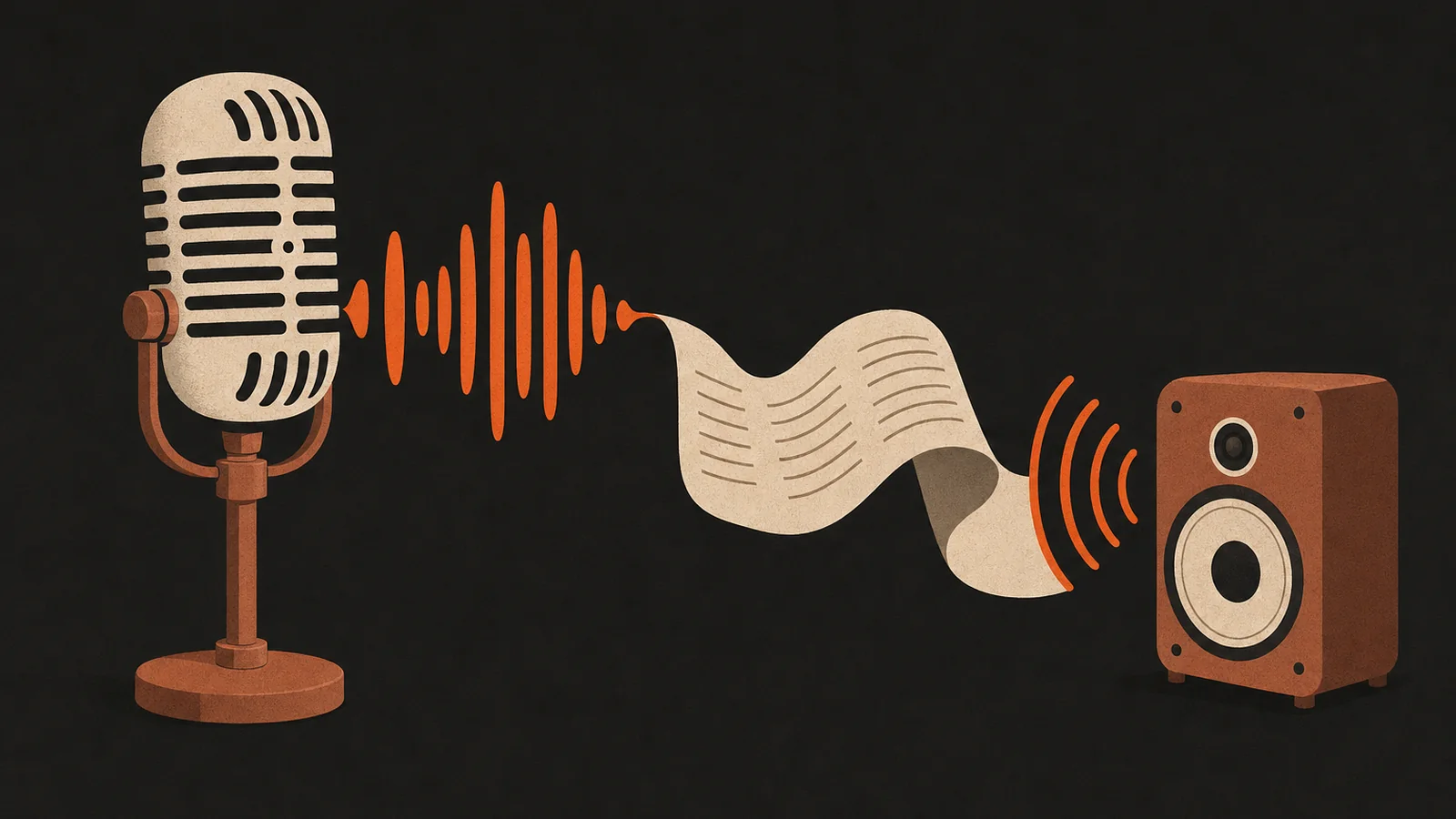
Illustration of a vintage microphone sending orange sound waves into a ribbon of paper covered in lines of text, which flows on into a wooden speaker: speech turned into text and back into a voice

001 / THE SHORT ANSWER

A SELF-HOSTED VOICE STACKON YOUR BOX
  • INMicrophone, recording or phone linecall audio, meeting, voice note
  • STTwhisper.cpp · faster-whisper · Parakeetspeech becomes text
  • BRAINA local or cloud language modeldecides what to say or do
  • TTSPiper · Kokorotext becomes a voice
  • GLUEPipecat · LiveKit Agentsstreaming, turn-taking, interruptions

For transcription, a Whisper model run through whisper.cpp or faster-whisper. For a voice, Kokoro or Piper. To join them into a voice agent, Pipecat or LiveKit Agents. All of them run on your own hardware, so audio never has to leave the building.

Voice AI breaks into three jobs, and most businesses only need the first:

  • ✓Speech-to-text turns calls, meetings and voice notes into searchable text (Whisper and its faster runners, Parakeet, Vosk)
  • ✓Text-to-speech reads text aloud in a synthetic voice (Piper, Kokoro, Coqui TTS)
  • ✓Voice agents listen, think and answer in real time, for example on a phone line (Pipecat, LiveKit Agents, plus a language model)

The brain in the middle is a language model; our list of open source local AI tools covers how to run one, and the local LLM hardware calculator estimates the machine it needs. Speech models themselves are small by comparison.

002 / THE LIST

These twelve held up when we checked each repository on 27 November 2026: maintained (or flagged where they aren't), clearly licensed, and runnable on hardware a small business can own or rent. Each card shows two licences: the code's, and the model's or voice's, because for speech AI those are often different.

SPEECH-TO-TEXT

Speech-to-text (transcription)

Turn recordings, meetings and calls into text. Four of the five run OpenAI's open Whisper models in different ways; Parakeet is NVIDIA's alternative.

01Whisper (OpenAI)

MIT
github.com/openai/whisper

The original open speech recognition model: multilingual transcription, translation into English and language detection, in six sizes from tiny to large plus a faster 'turbo' model. Most tools on this page build on its weights.

MODEL LICENCE
MIT
BEST FOR
The reference implementation: batch transcription in Python, and a baseline to test accuracy before you pick a faster runner.
HOW YOU RUN IT
pip install openai-whisper (needs ffmpeg), then a CLI such as whisper audio.mp3 --model turbo.
HARDWARE
README lists about 1 GB of GPU memory for tiny and base, about 6 GB for turbo and about 10 GB for large. CPU works, slowly
CAVEATS
Latest tagged release June 2025; commits continue at a slow pace, and most people now run the same models through whisper.cpp or faster-whisper. The model card warns it can output text that wasn't spoken (hallucination), so check transcripts that matter. Turbo isn't trained for translation.

02whisper.cpp

MIT
github.com/ggml-org/whisper.cpp

A C/C++ port of Whisper with no Python needed. Ships a command-line tool, a live microphone transcriber, voice activity detection and whisper-server, a small HTTP transcription server with an OpenAI-like API.

MODEL LICENCE
MIT (Whisper models, converted)
BEST FOR
Fast transcription on a Mac or an ordinary PC, a small office transcription server, or putting speech-to-text inside an app.
HOW YOU RUN IT
Pre-built Docker images (ghcr.io/ggml-org/whisper.cpp, CPU, CUDA and Vulkan variants) or build with CMake; download a model with the included script.
HARDWARE
CPU is fine for small models. On Apple Silicon it runs fully on the GPU through Metal; NVIDIA (CUDA) and Vulkan GPUs also supported
CAVEATS
whisper-server binds to 127.0.0.1:8080 by default and its docs list no login option, so keep it on localhost or behind an authenticating proxy (the Docker example binds 0.0.0.0). Speaker labels are only an experimental feature. Releases are frequent: pin a version.

03faster-whisper

MIT
github.com/SYSTRAN/faster-whisper

A reimplementation of Whisper on the CTranslate2 engine. Its README says it is up to four times faster than openai/whisper for the same accuracy, with less memory, and it adds 8-bit quantisation, batched transcription and a Silero voice-activity filter.

MODEL LICENCE
MIT (Whisper models)
BEST FOR
Python developers and server pipelines that transcribe a lot of audio. It is also the engine inside WhisperX.
HOW YOU RUN IT
pip install faster-whisper, then a few lines of Python. NVIDIA's CUDA Docker images carry the GPU libraries it needs.
HARDWARE
CPU with int8 works. GPU acceleration in the README is NVIDIA only and needs CUDA 12 with cuDNN 9
CAVEATS
A library, not an app: someone has to write the script or service around it. Latest release October 2025 with commits continuing into November 2026. Same hallucination caveat as Whisper.

04WhisperX

BSD-2-Clause
github.com/m-bain/whisperX

Whisper (through faster-whisper) plus accurate word-level timestamps from a separate alignment model and speaker diarisation, so a transcript says who spoke when.

Licence note: Speaker labels use pyannote's speaker-diarization-community-1 model, which is CC BY 4.0 but gated: you need a Hugging Face access token and must accept the model's user agreement before it downloads.

MODEL LICENCE
MIT (Whisper); diarisation model CC BY 4.0, gated
BEST FOR
Meeting, interview and call transcripts with speaker labels, and subtitles with tight timing.
HOW YOU RUN IT
pip install whisperx, then a CLI such as whisperx audio.wav --diarize.
HARDWARE
README says under 8 GB of GPU memory for large-v2 on NVIDIA. CPU mode works with --device cpu --compute_type int8, slower
CAVEATS
Alignment models are per language; English is covered by default. Speaker labels are 'Speaker 1, Speaker 2', not names. Latest release is a release candidate (June 2026), with commits in November 2026.

05NVIDIA NeMo Speech (Parakeet models)

Apache-2.0
github.com/NVIDIA-NeMo/Speech

NVIDIA's open toolkit for speech recognition, text-to-speech and speech LLMs. Its Parakeet models give fast English transcription with punctuation, capitals and word timestamps, and there are streaming models for live use.

Licence note: Check the licence on each model card. Parakeet TDT 0.6B v2 (English) and v3 (25 European languages) are CC BY 4.0, which allows commercial use with attribution. Newer NVIDIA speech models use the NVIDIA Open Model License or OpenMDW-1.1 instead.

MODEL LICENCE
Varies: Parakeet TDT v2 and v3 are CC BY 4.0
BEST FOR
High-volume transcription or live speech-to-text on an NVIDIA GPU server, as an alternative to Whisper.
HOW YOU RUN IT
pip install 'nemo-toolkit[asr,tts]' or NVIDIA's NGC container, then load a model by name in Python.
HARDWARE
Model cards say the models are designed and optimised for NVIDIA GPUs. Plan on one
CAVEATS
A large PyTorch toolkit aimed at researchers and developers. The repo moved from NVIDIA/NeMo to NVIDIA-NeMo/Speech in 2026 when NeMo was split up (old links redirect). Three different model licences in one family, so check each one.

OFFLINE TOOLKITS

Lightweight offline toolkits

Small, CPU-friendly speech engines for kiosks, Raspberry Pis, phones and apps written in languages other than Python.

06Vosk

Apache-2.0
github.com/alphacep/vosk-api

An offline speech recognition toolkit for 20+ languages with small models (around 50 MB), a zero-latency streaming API and a reconfigurable vocabulary. Bindings for Python, Java, Node.js, C#, Go and more.

MODEL LICENCE
Mostly Apache 2.0; a few models AGPL or LGPL
BEST FOR
Low-power devices, kiosks and voice commands with a known vocabulary, where a GPU is out of the question.
HOW YOU RUN IT
pip install vosk (or another language binding) plus a model from the Vosk models page; a separate vosk-server repo adds WebSocket and gRPC servers.
HARDWARE
CPU only, and modest. The small English model is about 40 MB
CAVEATS
Older Kaldi-based technology: test it against a Whisper-based tool on your own recordings before choosing it for general transcription. English models are US or Indian English. Latest tagged release April 2024, though code commits continued into October 2026.

07sherpa-onnx

Apache-2.0
github.com/k2-fsa/sherpa-onnx

An offline speech toolkit from the next-gen Kaldi team that runs many open models through ONNX Runtime: speech-to-text, text-to-speech, voice activity detection, speaker diarisation and identification, keyword spotting and more, with no internet connection.

MODEL LICENCE
Per model (Whisper, Parakeet, Piper, Kokoro and others)
BEST FOR
Developers putting speech into a desktop, mobile or embedded app, or a non-Python backend (it has bindings for 12 programming languages).
HOW YOU RUN IT
pip install sherpa-onnx, pre-built binaries and mobile libraries, or its WebSocket server.
HARDWARE
CPU first, down to small boards; also supports several NPUs
CAVEATS
A developer toolkit, not an app, and very broad. Each model you load keeps its own licence (for example Piper voices and Parakeet weights, above and below). Releases are frequent.

TEXT-TO-SPEECH

Text-to-speech (voices)

Turn text into spoken audio. The engine's licence and each voice's licence are separate questions, and for TTS the voice licence is usually the one that bites.

08Piper

GPL-3.0
github.com/OHF-Voice/piper1-gpl

A fast, local neural text-to-speech engine that runs comfortably on a CPU or a Raspberry Pi. Includes a command line, a Python and C/C++ API and a small web server. Home Assistant and the NVDA screen reader use it.

Licence note: The project grants no licence over voices. Many voices were fine-tuned from the 'lessac' voice, whose recordings are licensed for research only. Piper's COMMERCIAL_USE page lists voices whose whole training chain allows commercial use (for example en_GB-alba, en_GB-cori and en_GB-jenny_dioco, which must be credited as 'Jenny'). Some were retrained in late 2026 under the same name, so re-download and read each voice's MODEL_CARD.

MODEL LICENCE
Per voice; many voices not cleared for commercial use
BEST FOR
Quick, light voice output: phone menu prompts, announcements, reading text aloud, a voice for a local assistant.
HOW YOU RUN IT
pip install piper-tts, download a voice, then python3 -m piper.http_server -m <voice> for a web server on port 5000.
HARDWARE
CPU is enough
CAVEATS
The old rhasspy/piper repo (MIT) is archived; development moved to the Open Home Foundation under GPL-3.0, which matters if you ship it inside software you distribute. The project is looking for maintainers. The stock English voices are British or American; there's no Australian voice in the list.

09Kokoro

Apache-2.0
github.com/hexgrad/kokoro

An 82-million-parameter open-weight TTS model with natural-sounding preset voices. Its authors say it matches larger models on quality while being much faster, and both code and weights are Apache-licensed.

MODEL LICENCE
Apache 2.0 (Kokoro-82M)
BEST FOR
Natural narration and voice-agent replies on modest hardware, with the simplest licence on this list.
HOW YOU RUN IT
pip install kokoro plus espeak-ng, a few lines of Python. Pipecat, sherpa-onnx and several local AI servers can also run it.
HARDWARE
Small enough for a CPU; faster on a GPU
CAVEATS
The inference library has had no commits since August 2025 and has no tagged releases: the model works, but don't expect fixes. Preset voices only (American and British English plus Spanish, French, Hindi, Italian, Japanese, Mandarin and Brazilian Portuguese), no voice cloning and no Australian voice.

10Coqui TTS (Idiap fork)

MPL-2.0
github.com/idiap/coqui-ai-TTS

A deep-learning TTS toolkit with many models (VITS, XTTS v2 with voice cloning in 17 languages, and Fairseq models covering about 1,100 languages), plus training and fine-tuning recipes and a demo server.

Licence note: XTTS v2, the best-known Coqui model and the one used for voice cloning, is under the Coqui Public Model License, which allows only non-commercial use of the model and its outputs. Other models in the toolkit have their own licences.

MODEL LICENCE
Per model; XTTS v2 is non-commercial
BEST FOR
Teams that want to train or fine-tune their own voice, or compare many TTS models in one toolkit.
HOW YOU RUN IT
pip install coqui-tts, or the ghcr.io/idiap/coqui-tts Docker images with a built-in demo server on port 5002.
HARDWARE
CPU works for small models; a GPU for XTTS and any training
CAVEATS
Coqui, the company, closed in early 2024 and its original coqui-ai/TTS repo is unmaintained; this fork by the Idiap Research Institute is the active one, published as the coqui-tts package. MPL-2.0 is a file-level copyleft: share changes to its own files if you distribute them.

VOICE AGENTS

Voice agent frameworks

The glue for a voice bot or phone agent: they stream audio in, call speech-to-text, a language model and text-to-speech, and handle interruptions. You still choose each part.

11Pipecat

BSD-2-Clause
github.com/pipecat-ai/pipecat

An open source Python framework for real-time voice agents, maintained by Daily and the community. It chains speech-to-text, a language model and text-to-speech with interruption handling, over WebRTC, WebSockets or phone lines.

MODEL LICENCE
n/a (you choose the models)
BEST FOR
Developers building a web or phone voice agent who want to pick every part, including fully local ones: it has services for Whisper, Piper, Kokoro, XTTS and Ollama alongside the cloud providers.
HOW YOU RUN IT
uv add pipecat-ai (or pip install) and run your agent as a Python process; examples cover phone calls through Twilio, Telnyx, Plivo, Vonage and others.
HARDWARE
The framework itself is light. Running speech-to-text, the language model and TTS locally with quick replies usually needs a decent GPU
CAVEATS
A framework, not a finished receptionist: you write the conversation logic, testing and escalation. A phone agent still needs a telephony carrier for the number and the call audio. Pipecat Cloud is an optional hosted service; you don't need it to self-host.

12LiveKit Agents

Apache-2.0
github.com/livekit/agents

A framework (Python and Node.js) for real-time voice agents on top of LiveKit, an open source WebRTC media server. Includes semantic turn detection, telephony through LiveKit SIP, and plugins for dozens of speech and model providers.

Licence note: The framework is Apache-2.0, but LiveKit's turn-detection models are under the LiveKit Model License: free to use, but proprietary and only allowed with the LiveKit Agents framework.

MODEL LICENCE
Turn-detector model: LiveKit Model License
BEST FOR
Voice agents that need to scale across many simultaneous web or phone conversations, if you're willing to run LiveKit's server stack.
HOW YOU RUN IT
pip install livekit-agents with the plugins you need; self-host LiveKit server and LiveKit SIP (both Apache-2.0) or use LiveKit Cloud.
HARDWARE
The agent and server are light; local models bring their own GPU needs
CAVEATS
More moving parts than Pipecat (media server, SIP service, agent workers). The quick-start examples use LiveKit's cloud inference; to stay self-hosted, point the OpenAI plugin at a local endpoint such as Ollama and run your own server.

Checked: 27 November 2026, on each project's GitHub repository (licence, releases, recent commits), its official docs, and the model cards for the weights it uses. Projects and model licences change; read the current README and the model or voice licence before you install.

003 / SIDE BY SIDE

Every code licence here allows business use; the differences that matter are the model licences and how much building each one needs. Green code licences are permissive, amber ones are copyleft (fine to run internally, with conditions if you distribute changes).

Open source voice AI tools compared by job, code licence, model licence, platforms, best use and main catch (checked 27 November 2026)
ToolDoesCode licenceModel / voice licenceRuns onBest forMain catch
WhisperSpeech-to-textMITMITMac, Windows, Linux (Python)Reference model, Python batch jobsSlow; few releases
whisper.cppSpeech-to-textMITMIT (Whisper models, converted)Mac, Windows, Linux, Docker, Raspberry Pi, iOS, Android, browser (WebAssembly)Mac or PC, small serverServer has no login
faster-whisperSpeech-to-textMITMIT (Whisper models)Linux, Windows, Mac (Python)High-volume server transcriptionLibrary; NVIDIA GPU for speed
WhisperXSTT + speakersBSD-2-ClauseMIT (Whisper); diarisation model CC BY 4.0, gatedLinux, Windows, Mac (Python; CPU mode on Mac)Meetings and interviewsGated diarisation model
NeMo / ParakeetSpeech-to-textApache-2.0Varies: Parakeet TDT v2 and v3 are CC BY 4.0Linux (Python); NGC containersEnglish at scale on NVIDIAHeavy toolkit; mixed model licences
VoskSpeech-to-textApache-2.0Mostly Apache 2.0; a few models AGPL or LGPLLinux, Windows, Mac, Raspberry Pi, Android, iOSKiosks, Pi, voice commandsOlder accuracy
sherpa-onnxSTT, TTS and moreApache-2.0Per model (Whisper, Parakeet, Piper, Kokoro and others)Windows, Mac, Linux, Android, iOS, Raspberry Pi and other embedded boardsOffline speech inside appsDeveloper toolkit
PiperText-to-speechGPL-3.0Per voice; many voices not cleared for commercial useLinux, Windows, Mac, Raspberry PiFast voices on a CPUCheck each voice's licence
KokoroText-to-speechApache-2.0Apache 2.0 (Kokoro-82M)Linux, Windows, Mac (Python)Natural voices, simple licenceNo updates since Aug 2025
Coqui TTSText-to-speechMPL-2.0Per model; XTTS v2 is non-commercialLinux, Windows, Mac (Python), DockerTraining your own voiceXTTS v2 non-commercial
PipecatVoice agent frameworkBSD-2-Clausen/a (you choose the models)Linux, Mac, Windows (Python)Custom phone or web agentsYou build the logic
LiveKit AgentsVoice agent frameworkApache-2.0Turn-detector model: LiveKit Model LicenseLinux, Mac, Windows; LiveKit server via Docker or binaryAgents at scale over WebRTC/SIPMore services to run

004 / WHICH ONE SHOULD YOU PICK

Start from the job, not the model. For most small businesses the first useful step is transcription with whisper.cpp or faster-whisper; voices and voice agents come later, if at all.

IF: TRANSCRIBE MEETINGS ON A MAC

whisper.cpp

Runs on the Apple Silicon GPU through Metal, needs no Python, and its server gives other tools a local transcription endpoint. Use a larger model if accuracy on accents matters more than speed.

IF: WHO SAID WHAT, WITH TIMINGS

WhisperX

Adds speaker labels and word-level timestamps to Whisper. Best on an NVIDIA GPU; budget a few minutes to set up the Hugging Face token the diarisation model needs.

IF: LOTS OF AUDIO ON A GPU SERVER

faster-whisper, or Parakeet for English

faster-whisper is the easy Python route with Whisper's multilingual coverage. Parakeet is worth a side-by-side test if your audio is English and the server has an NVIDIA card.

IF: A NATURAL VOICE FOR NARRATION OR REPLIES

Kokoro, or Piper with a commercial-use voice

Kokoro sounds more natural and has the cleaner licence. Piper is lighter and more actively maintained; choose a voice from its commercial-use list and keep the MODEL_CARD with it.

IF: OFFLINE ON A KIOSK, PI OR PHONE

sherpa-onnx, or Vosk for simple commands

sherpa-onnx runs modern models with no internet from C, C++, Java, Kotlin, Swift, JavaScript and more. Vosk is the lightest option when the vocabulary is small and known.

IF: A SELF-HOSTED PHONE OR WEB VOICE AGENT

Pipecat (simpler) or LiveKit Agents (scale)

Both are frameworks for developers. If you just want calls answered, compare a managed option first in our AI receptionist guide.

005 / LICENCES

Because what you ship is the model's output, and the model or voice often has its own, stricter licence than the code that runs it. Every code licence on this list allows business use. Three model situations need care:

  • ✓Coqui XTTS v2 is under the Coqui Public Model License, which allows only non-commercial use of the model and its outputs, even though the toolkit itself is MPL-2.0.
  • ✓Piper voices carry the licence of their training recordings, and many descend from a research-only dataset. Piper's own docs list the voices cleared for commercial use, and note some were retrained in late 2026 under the same names.
  • ✓NVIDIA's speech models use three different licences (CC BY 4.0, the NVIDIA Open Model License, OpenMDW). WhisperX's diarisation model is CC BY 4.0 but gated behind a user agreement, and LiveKit's turn detector only works under its own model licence with LiveKit Agents.
  • ✓The simple ones: Whisper's weights are MIT, Kokoro-82M is Apache 2.0, and most Vosk models are Apache 2.0.

Copyleft code is also worth a minute: Piper's engine is now GPL-3.0 and Coqui TTS is MPL-2.0. Running them internally is fine; building them into software you sell or hand to customers brings source-sharing obligations.

006 / VOICE CLONING

Only with the speaker's written consent, for a stated use, and never on a phone line or anything that verifies identity. Some tools here, Coqui's XTTS v2 for one, can copy a voice from a short sample, and none of them can check that the person agreed.

  • ✓Get written consent from the speaker that names what the cloned voice will be used for, and keep it
  • ✓Never clone a customer's, a public figure's or a former employee's voice
  • ✓Tell listeners when they're hearing a synthetic voice; misleading people is a consumer law problem whatever the tool
  • ✓Keep the voice samples and the cloned voice on a locked-down machine, and delete them when the use ends
  • ✓Check the model's licence before using its output commercially (XTTS v2 output can't be)

We wrote about this in detail, with a checklist, in our piece on open source voice cloning with VoiceStudio. Scammers already use cloned voices, so don't train your customers to trust one on the phone.

007 / RECORDING AND PRIVACY

Tell people you're recording and transcribing, get agreement where the law requires it, and treat transcripts as personal information. Self-hosting changes where the audio goes, not whether these rules apply. This is general information, not legal advice.

  • ✓Recording consent differs by state and territory. Some surveillance and listening devices laws require the consent of everyone in a private conversation; others allow a participant to record in limited cases. Federal telecommunications law also applies to phone calls. Announcing the recording at the start of each call or meeting is the safe practice everywhere.
  • ✓The Privacy Act 1988 and the Australian Privacy Principles apply to recordings and transcripts if your business is covered. Collect only what you need, explain it in your privacy policy and collection notices, secure it, and set a retention period.
  • ✓Overseas disclosure (APP 8) is where local tools help: transcribing on your own server means call audio isn't sent to an overseas speech API.
  • ✓Voiceprints are sensitive. Biometric information used to verify or identify a person, such as a voiceprint for speaker identification, is sensitive information under the Privacy Act, with stricter collection rules.

More detail in our Privacy Act guide for AI in business.

008 / LEFT OUT

Chatterbox and Bark are the two best-known names missing. Both are MIT licensed and both still work, but neither is maintained.

  • ✓Chatterbox (github.com/resemble-ai/chatterbox, MIT): its README says that as of August 2026 it is retired research and no longer maintained, kept public as an archive with no support or updates.
  • ✓Bark (github.com/suno-ai/bark, MIT): no code changes since April 2024, and it can't use custom voices.
  • ✓The original Coqui TTS and Piper repos (coqui-ai/TTS and rhasspy/piper): the first is unmaintained and the second is archived. Their active successors are on the list.
  • ✓Fish Speech (github.com/fishaudio/fish-speech): active, but under the Fish Audio Community License, which allows commercial use only below a revenue threshold. Not an open source licence.
  • ✓Speaches (github.com/speaches-ai/speaches, MIT): a handy OpenAI-compatible server for faster-whisper, Piper and Kokoro, but no code changes since April 2026 and its latest release is still a release candidate. Worth watching.

Building other parts of a free stack? See our lists of self-hosted automation tools and open source business apps, or the local AI starter stack.

009 / WHERE WE CAN HELP

When it answers your customers, when the recordings hold personal information, or when it has to write into your other systems. Transcribing your own voice notes with whisper.cpp needs no consultant. A voice agent on your main phone line needs someone to own testing, escalation, recording notices and updates.

We're a Sydney team working remotely across Australia and New Zealand. Our AI voice assistants service builds receptionists that answer, book and hand over to a person, and our private AI work covers keeping models and data on infrastructure you control. When transcripts need to flow into a CRM or a ticket, see n8n consultants. Every build is scoped and priced in writing.

010 / QUESTIONS

Anything else is quicker to answer on a call. Thirty minutes, free, with the people who would build it.

For most businesses, a Whisper model run through whisper.cpp (on a Mac or ordinary PC) or faster-whisper (on a server with an NVIDIA GPU). Both are MIT licensed, as are the Whisper weights. Add WhisperX when you need speaker labels and word timings, and look at NVIDIA's Parakeet models if you transcribe a lot of English on NVIDIA hardware. Test on your own recordings: accents, phone audio and background noise change results more than any benchmark.

Tell us what you record, who needs the text and what hardware you have. In thirty minutes we'll suggest a setup from this list, or tell you honestly if a managed service is the better fit.

Book a free call→