
As the Australian economy progresses through 2026, the adoption of Artificial Intelligence (AI) has shifted from a speculative trend to a fundamental operational imperative for Small and Medium-sized Businesses (SMBs).
As the Australian economy progresses through 2026, the adoption of Artificial Intelligence (AI) has shifted from a speculative trend to a fundamental operational imperative for Small and Medium-sized Businesses (SMBs). This report, 2026 State of AI Adoption in Australian SMBs, is a desk review of published Australian research. By synthesizing data from leading economic bodies—including the Tech Council of Australia, Deloitte Access Economics, the National AI Centre (NAIC), and the Australian Bureau of Statistics—this document offers an exhaustive evaluation of how AI automation is reshaping the nation's commercial landscape.
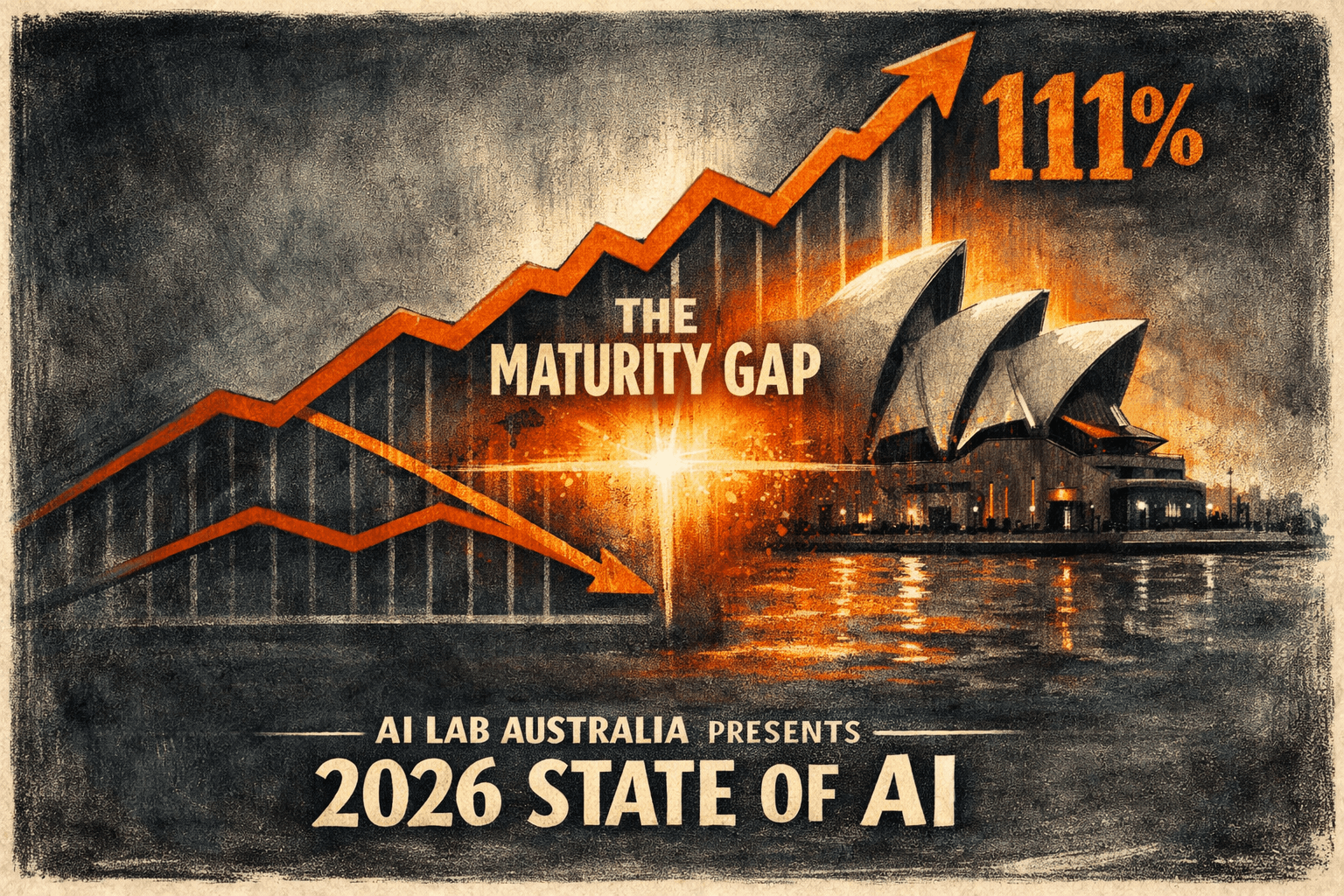
The 2026 data reveals a "two-speed" digital economy. The National AI Centre's SME AI Pulse found that 44% of Australian SMEs had adopted AI in some form in February 2026 (43% across December 2025 to February 2026), largely driven by accessible Generative AI (GenAI) tools. Formal workplace use is far lower: the ABS found around 12% of Australian businesses used AI in their workplace in 2024–25. The gap between trying AI and building it into operations is the "maturity gap." Only a small minority of SMBs are "fully enabled," possessing the strategic foresight, centralized data infrastructure, and workforce capability to unlock transformative business value through AI automation.
The economic implications of closing this gap are significant. Deloitte Access Economics' modelling (November 2025, a survey of 1,000 Australian SMBs commissioned by Amazon Australia) estimates that SMBs moving from 'basic' to 'intermediate' AI maturity could see profitability rise by about 45%, and those moving from 'intermediate' to 'fully enabled' by roughly 111%. Deloitte estimates that if one in ten SMBs advanced one step on this ladder, annual GDP could increase by around $44 billion.
Sectoral divergence remains a defining feature of the 2026 landscape. Professional Services and Retail sectors act as the nation's digital trailblazers, leveraging AI for hyper-personalization and administrative automation. In contrast, the "physical" industries—Agriculture, Construction, and Manufacturing—face steeper adoption curves driven by high capital expenditure requirements. Yet, these sectors are beginning to deploy high-impact "Agentic AI" applications, from autonomous weeding robots in agriculture to predictive maintenance automation in manufacturing, supported by targeted government interventions like the National Reconstruction Fund (NRF).
The regulatory environment has matured significantly. The pivot from the 2024 Voluntary AI Safety Standard to the Guidance for AI Adoption, released in late 2025, has provided a stable, principles-based framework that balances safety with innovation. However, barriers to scale persist. The conversation has moved beyond abstract fears of "robot overlords" to concrete operational hurdles: an acute shortage of skilled "AI Translators" in the workforce, data sovereignty concerns, and the challenge of calculating ROI for complex integrations.
This report serves as a roadmap for Australian business leaders, policymakers, and investors, detailing the opportunities and risks inherent in the next phase of the AI revolution.
Australia enters 2026 facing a continued productivity paradox. Despite a resilient labor market, productivity growth—the ultimate engine of living standards—has remained sluggish. For the SMB sector, which makes up the overwhelming majority of Australian businesses, this stagnation presents an existential threat. Rising input costs, persistent skill shortages, and global supply chain volatility have eroded margins. In this high-cost operating environment, efficiency is no longer optional; it is survival.
Artificial Intelligence has emerged as the primary lever to break this deadlock. Unlike previous technological waves that digitized existing processes (e.g., email replacing letters), AI offers the capability to cognitively augment the workforce. It promises to decouple revenue growth from headcount growth, allowing Australian SMBs to scale output through intelligent automation without proportionally scaling costs. AI can lift labor productivity in critical industries, helping to mitigate the impact of workforce shortages.
The "2026 State of AI Adoption" reveals a stark bifurcation in the market.
This divide is not merely digital; it is financial. Businesses that are already growing have more room to invest in AI, creating a self-reinforcing cycle where the productive get more productive, and the laggards fall further behind.
This report is a desk review of published research, not an original survey: AI Lab Australia did not survey businesses for it. It draws upon:
The analysis focuses on "Small and Medium Businesses" (employing 1–199 staff), distinguishing between "Micro" (0–4), "Small" (5–19), and "Medium" (20–199) enterprises where data permits, to highlight the nuanced challenges faced by businesses of different scales.
Two official measures describe where Australian businesses stand in early 2026, and they measure different things. The National AI Centre's SME AI Pulse, a monthly survey of at least 400 SME owners and decision-makers run by Fifth Quadrant, found 44% of SMEs had adopted AI at some level in February 2026, including occasional chatbot use. The ABS Business Characteristics Survey 2024–25, which surveyed nearly 7,000 businesses between October 2025 and February 2026, found around 12% of businesses used AI in their workplace. Read together, close to half of SMEs have tried AI, but only about one in eight has built it into how the business runs.
Adoption is heavily correlated with business size, revealing a structural disadvantage for the smallest operators.
Table 1: Workplace AI Use by Business Size (ABS, 2024–25)
| Business Size | Employee Count | Workplace AI Use | Change Since 2021–22 | What It Means |
|---|---|---|---|---|
| Small and micro | 0–19 Employees | Around 11% | Not reported | Lagging: adoption constrained by a lack of dedicated IT resources and time. |
| Medium | 20–199 Employees | 22% | Up from 3% | Accelerating: investment in custom workflows and business licences. |
| Large | 200+ Employees | Around 35% | Up from 9% | Maturing: the focus is shifting from adoption to governance and scale. |
Source: ABS, Characteristics of Australian Business 2024–25.
Insight: The "Micro-Gap" is a critical policy concern. While large firms deploy dedicated teams to implement AI, micro-business owners must act as their own CIOs. At around 11% workplace use, the smallest businesses mostly rely on free, consumer-grade tools (like ChatGPT) rather than systematic business integration.
A binary "user vs. non-user" metric is insufficient for 2026. The true story lies in the depth of integration. Deloitte Access Economics' AI Maturity Index places SMBs on three tiers:
1. Basic Users:
2. Intermediate Users:
3. Fully Enabled:
Strategic Implication: The "Missing Middle" is closing, but the leap to "Fully Enabled" remains elusive. The complexity of orchestrating data privacy, security, and integration prevents most SMBs from reaching the top tier.
How does Australia compare?
The technological landscape of 2026 differs markedly from 2024. The novelty of "chatting" with a bot has faded, replaced by a demand for autonomy and action.
The most significant trend of 2026 is the transition to Agentic AI.
For an SMB, an "Agent" acts as a digital employee. Instead of a user prompting ChatGPT to "write an email," an Agent can be instructed to "manage the inbox," autonomously reading, categorizing, drafting replies, and only asking for human approval on high-priority items. This capability is particularly transformative for resource-constrained SMBs, effectively allowing them to "hire" digital staff for administrative, marketing, and logistical roles.
Australian SMBs are deploying AI across five primary domains:
Table 2: Top AI Applications in Australian SMBs
| Application Domain | Key Use Case | Business Value |
|---|---|---|
| Data Entry & Processing | Automating invoice extraction with custom OCR training and form filling. | Reducing "boring" admin hours; improving data accuracy. |
| Generative Assistants | Coding assistance, content drafting, legal summarization. | Accelerating creative and technical output. |
| Fraud Detection | Real-time transaction monitoring for retail/finance. | Mitigating cyber risk and financial loss. |
| Predictive Analytics | Cash flow forecasting; Inventory demand planning. | Optimizing working capital and reducing waste. |
| Marketing Automation | Personalized customer journeys with AI chatbots; dynamic content generation. | Increasing conversion rates and customer LTV. |
Insight: The tie for first place between "Data Entry" and "Generative Assistants" highlights the dual nature of AI value: it automates the mundane (Data Entry) while augmenting the creative (Assistants).
Status: The Trailblazers
The Professional Services sector (Legal, Accounting, Consulting, ICT) leads the nation in AI maturity. These industries deal primarily in information—text, code, and numbers—making them the natural habitat for Large Language Models (LLMs).
Consider a boutique financial planning firm in Sydney. By integrating AI voice assistants into their CRM:
Result: The planner spends far less time on admin and more on client relationships.
Status: The Fast Followers
Retail is leveraging AI to survive in a fiercely competitive, low-margin environment.
Australian retailers are moving beyond basic segmentation to Hyper-Personalization. AI engines analyze individual purchase history, browsing behavior, and even local weather patterns to tailor marketing messages.
"Dead stock" is a margin killer. Predictive Analytics tools are becoming essential for SMB retailers to forecast demand.
The 2026 consumer expects 24/7 support. SMBs are deploying advanced AI chatbots that can handle complex queries (e.g., "Where is my order?" or "How do I return this?") without human intervention, resolving a large share of routine tickets.
Insight: In hospitality, AI is reshaping the "back of house" with automated rostering systems that predict busy periods to optimize staffing levels, crucial in an era of high penalty rates.
Status: The Awakening Giant
Historically one of the least digitized sectors, Construction is adopting AI as firms realize that AI is the solution to the industry's chronic budget overruns and schedule delays.
The integration of AI into BIM software is the catalyst. AI plugins can now:
Computer Vision is being deployed on job sites. Cameras analyze video feeds in real-time to detect safety violations (e.g., workers missing hard hats) or hazards (e.g., potential falls), triggering immediate alerts.
While primarily in manufacturing/research, the principles used by companies like Ion Opticks (recipients of government expansion grants) demonstrate the value of high-tech manufacturing capability. Similarly, construction firms are using sensors on cranes and excavators to predict mechanical failure, shifting from "fix when broken" to "fix before breaking".
Status: High-Tech Niche vs. General Lag
Agriculture presents a dichotomy. While overall adoption is modest, the "High-Tech" segment of Australian AgTech is world-leading, driven by the absolute necessity of managing vast land areas with minimal labor.
Government investment is accelerating this sector. The National Reconstruction Fund's investment in Applied EV (creators of the 'Blanc Robot' autonomous vehicle) is a prime example. These driverless, cabin-less vehicles are designed for industrial settings, including agriculture, offering a modular platform for spraying, monitoring, and harvesting without human operators.
Despite these advances, the "digital divide" is starkest here. Connectivity issues in regional Australia remain a primary barrier. Without reliable 5G or high-speed satellite links, cloud-based AI tools are rendered useless, trapping many small family farms in analog operations.
The greatest inhibitor to AI adoption in 2026 is not technology, but talent.
Fears of mass unemployment have largely not materialized by 2026. Instead, the narrative is one of Augmentation.
The "Wild West" era of 2023 is over. 2026 is the era of Governance.
Australia has adopted a distinct regulatory path compared to the EU. Rather than a sweeping "AI Act," the Australian Government pursues a Technology-Neutral approach, reinforcing existing laws (Privacy, Consumer Law, Human Rights) while providing specific guidance for AI.
While general business use remains under voluntary guidance, Mandatory Guardrails are emerging for high-risk settings (e.g., healthcare, law enforcement, critical infrastructure). For the average SMB, the compliance burden is currently low, but the expectation of "Duty of Care" is rising. Courts and tribunals are increasingly likely to view failure to oversee AI (e.g., a chatbot promising a refund it shouldn't) as a breach of consumer law.
Data privacy is the "sleeper issue" of 2026. With employees widely concerned about data misuse, SMBs are becoming cautious about "Public AI" (like the free version of ChatGPT). There is a mass migration toward "Enterprise AI"—private instances of models where data is not used for training.
Recognizing the productivity opportunity, the Australian Government has deployed significant capital and programmatic support.
The NRF is actively shaping the supply side of the AI ecosystem.
Industry bodies continue to lobby for tax incentives for AI-related spending (software, training, hardware) to de-risk adoption for smaller players.
The economic modelling is clear: AI is the single largest lever available to pull Australia out of its productivity slump.
Why could AI maturity lift profits by as much as Deloitte estimates (about 45% to 111%)?
Despite the optimism, the path forward is not frictionless.
Looking ahead, we anticipate:
The "2026 State of AI Adoption" reveals a nation in transition. Australia possesses the ingredients for success: a digitally literate population, strong government backing, and a flexible economy. However, the "Maturity Gap" threatens to stall progress. The imperative for the remainder of the decade is clear: we must move beyond the novelty of "Chatting with AI" to the serious business of "Building with AI."
For Australian SMBs, the window of early-adopter advantage is closing; AI is becoming the new baseline for competitive viability. Whether you need AI chatbots for customer service, voice automation for phone support, custom invoice processing solutions, or comprehensive business automation strategy, the time to act is now.
Ready to close your AI maturity gap? Contact AI Lab Australia for a free consultation and find out where AI would make the biggest difference in your business.
This report was compiled in January 2026 and updated in September 2026 with the National AI Centre SME AI Pulse (February 2026) and the ABS Business Characteristics Survey 2024–25 (released June 2026).
Get expert guidance on implementing research report solutions for your Australian business