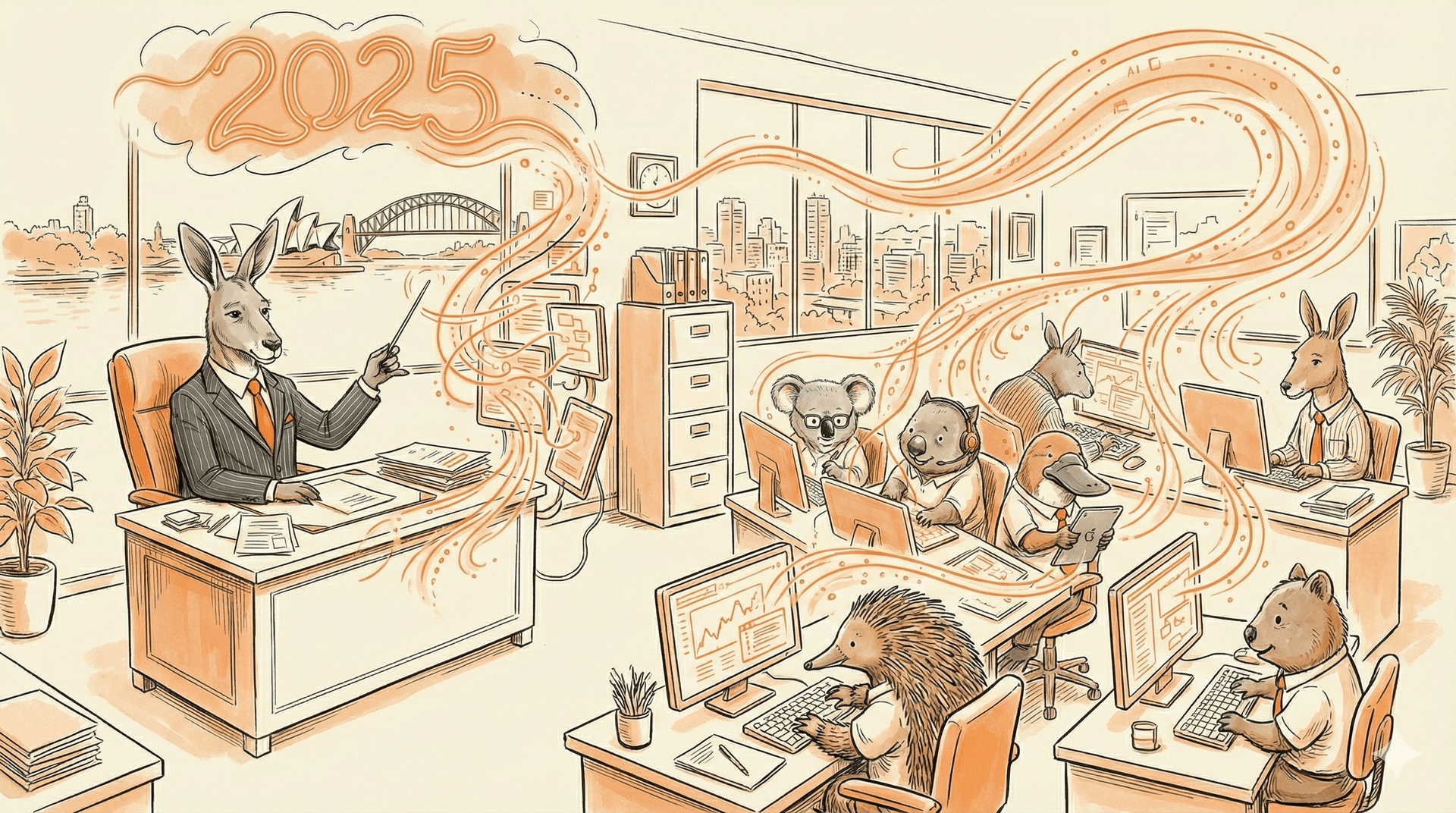

GPT-5.2 marks the end of the 'Big Iron' AI era. With 390x cost reduction in reasoning, <1% hallucination rates, and 11x faster performance, it's the first AI to pass the economic AGI test. Discover how adaptive compute and thought tokens are transforming Australian business operations.

The history of artificial intelligence, particularly in its generative epoch, has been defined by a singular, overwhelming metric: scale. For the better part of a decade, the "Scaling Hypothesis" served as the immutable law of the land. It posited that the performance of a Large Language Model (LLM) was strictly a function of the compute expended during training, the size of the dataset ingested, and the number of parameters in the network.
This era, characterized by the transition from GPT-3 to GPT-4, was the era of "Big Iron" AI—massive, monolithic models that required nuclear-scale energy to train and substantial, fixed computational resources to query. In this paradigm, "intelligence" was a static property; a model was as smart as its training run, and every query, whether asking for a haiku or a cure for cancer, cost roughly the same amount of compute to process.
The release of GPT-5.2 marks the definitive end of that era and the beginning of the Inference Efficiency Era.
The "breakthrough" delivered by OpenAI is not merely that the model knows more facts or writes more elegant prose—though it does both—but that it utilizes its cognitive resources with radically improved economic and computational viability. GPT-5.2 represents a fundamental architectural pivot from static inference to Adaptive Compute, a mechanism that allows the model to dynamically allocate "thinking time" based on the complexity of the task at hand.
This shift transforms AGI from a scientific curiosity, theoretically capable but economically prohibitive, into a practical utility that passes the "AGI Test" not just on accuracy, but on Return on Investment (ROI).
The traditional definition of Artificial General Intelligence (AGI) has often been trapped in the philosophical "Turing Test" paradigm—can a machine indistinguishably mimic a human? However, as AI permeates the real economy, this definition has proven insufficient.
A machine that mimics a human but costs $10,000 per hour to operate is not a replacement for human labor; it is a luxury good.
The true "AGI Test," as implied by the benchmarks accompanying the GPT-5.2 launch, is an economic one:
Can the system perform high-value knowledge work at a level of quality indistinguishable from an expert, but at a marginal cost and latency that renders human labor economically uncompetitive for those specific tasks?
The data suggests that GPT-5.2 is the first model to pass this Efficiency AGI Test.
On the GDPval benchmark, which simulates real-world professional tasks across 44 occupations, GPT-5.2 does not just match human performance; it delivers expert-level outputs at:
This is not an incremental gain of 10% or 20%; it is an order-of-magnitude collapse in the cost of cognition. It suggests that for a vast swath of the economy, the "price" of intelligence is about to decouple from the cost of human living standards.
For years, the industry operated under the assumption that there was a zero-sum trade-off between quality and efficiency. You could have a "smart" model (like GPT-4) that was slow and expensive, or a "fast" model (like GPT-3.5 Turbo) that was prone to hallucination and logic errors.
GPT-5.2 shatters this dichotomy through its tiered architecture (Instant, Thinking, and Pro). By utilizing Thought Tokens—intermediate reasoning steps that occur in the latent space—the model can "think" its way through complex problems, achieving 90%+ accuracy on the rigorous ARC-AGI-1 benchmark while reducing the computational cost to achieve that score by nearly 390 times compared to previous reasoning prototypes like o3-preview.
This report will argue that efficiency is the new quality.
In a production environment, a model that gets the answer right on the first try (high pass@1 rate) is infinitely more efficient than a faster model that requires five retries. GPT-5.2’s breakthrough is that it optimizes the Total Cost of the Answer, not just the cost per token.
By integrating a Semantic Router that directs queries to the appropriate level of compute, OpenAI has created a system that is "cheap enough for a chatbot, smart enough for a PhD".
To understand why GPT-5.2 is an efficiency breakthrough, we must look "under the hood" at the architectural innovations that drive it. Unlike previous generations, which were essentially static mathematical functions, GPT-5.2 is a dynamic system that treats "compute" as a fluid resource to be deployed strategically.
The central nervous system of GPT-5.2 is a sophisticated Semantic Router. This component sits between the user’s API request and the model weights, acting as a traffic controller for cognitive load. It has been trained on millions of examples of user intent, success rates, and "model switching" behaviors to instantly assess the complexity of a prompt.
This router directs traffic to one of three distinct model variants, each optimized for a specific point on the efficiency curve:
GPT-5.2 Instant ("System 1"):
GPT-5.2 Thinking ("System 2"):
GPT-5.2 Pro ("Apex Compute"):
The most significant technical innovation in GPT-5.2 is the productization of Thought Tokens (or latent reasoning states).
The Old Way (GPT-4):
The New Way (GPT-5.2):
Benefits:
A "High" setting might trigger thousands of internal thought tokens to solve a math proof, while "Low" might trigger only a few dozen for a quick logic check.
| Feature | GPT-4 / GPT-5.1 | GPT-5.2 (Adaptive) | Efficiency Impact |
|---|---|---|---|
| Reasoning Visibility | Explicit (Output Tokens) | Latent (Thought Tokens) | User pays only for result, not process |
| Compute Allocation | Static (Fixed per token) | Dynamic (Per reasoning.effort) | Resources matched to task difficulty |
| Context Management | Attention Dilution | "Recall Robustness" & Compression | 400k window effectively usable |
| Error Correction | Post-Hoc (User re-prompts) | Pre-Hoc (Internal verification) | Massive reduction in retry rates |
A major source of inefficiency in previous models was the degradation of performance as the context window filled up—a phenomenon known as "lost in the middle." Users would feed a model a 100-page document, and it would forget the details in the middle 50 pages.
GPT-5.2 introduces Recall Robustness via advanced positional encodings and a /compact endpoint that compresses embeddings dynamically. This allows the model to maintain near-perfect recall even at the 256k-400k token limit.
Efficiency Implication: This enables "One-Shot" Document Processing. Instead of chunking a document into ten parts and summarizing them individually (10 API calls + aggregation overhead), a user can feed the entire book, codebase, or legal discovery file into GPT-5.2 in a single pass.
The ability to "ingest the textbook, the supplementary materials, and then emit an entire, fully worked set of solutions" fundamentally changes the unit economics of data processing.
To substantiate the claim of an "efficiency breakthrough," we must analyze the benchmarks used to validate GPT-5.2. The most novel and economically relevant of these is GDPval.
GDPval is an internal OpenAI benchmark designed to measure the "economic value" of a model. Unlike academic benchmarks that test abstract logic (like MMLU), GDPval tests the model’s ability to perform "well-specified knowledge work tasks" across 44 occupations that contribute significantly to the US GDP.
Scope: Tasks include:
Occupations tested:
The results of GPT-5.2 on GDPval are the strongest evidence for the "Efficiency Singularity":
GPT-5.2 delivers "finished work products" rather than short answers.
The Old Inefficiency (GPT-4):
The New Efficiency (GPT-5.2):
Implication: By crossing the "last mile" of formatting and file generation, GPT-5.2 eliminates the switching costs between the AI and the work tool. The "efficiency" is not just in the thinking; it is in the doing.
While GDPval measures economic utility, the Abstraction and Reasoning Corpus (ARC-AGI) measures pure, fluid intelligence. It is the only benchmark that cannot be solved by memorizing the internet, as it consists of novel visual puzzles that require learning a new rule from just 2-3 examples.
For years, ARC-AGI was the graveyard of LLMs, with models scoring poorly compared to humans. GPT-5.2 has shattered this ceiling:
The most significant statistic for efficiency analysis:
GPT-5.2 Pro achieved its ARC-AGI-1 performance while reducing the cost to reach that level by roughly 390 times compared to the o3-preview model.
Context: The o3-preview was likely a massive, unoptimized reasoning model that "thought" for extended periods, burning immense compute. GPT-5.2 has distilled that capability into a streamlined, commercially viable architecture.
Interpretation: A 390x improvement in efficiency is akin to Moore’s Law compressing a decade of progress into a single release cycle. It transforms "Reasoning" from a scarce resource into a commodity.
The ARC Prize leaderboard provides a direct "dollars-and-cents" comparison of intelligence efficiency:
| System | ARC-AGI-2 Score | Cost Per Task | Efficiency Insight |
|---|---|---|---|
| GPT-5.2 (X-High) | 52.9% | ~$1.90 | High performance at commercial price |
| GPT-5.2 Thinking (High) | 43.3% | ~$1.39 | Sweet spot for price/performance |
| Gemini 3 Deep Think | 45.1% | ~$77.16 | ~40x more expensive for worse performance |
| Gemini 3 Pro | 31.1% | ~$0.81 | Cheaper, but fails reasoning threshold |
| Claude Opus 4.5 | 37.6% | ~$2.40 | Less efficient reasoning per dollar |
Analysis: This table is the "smoking gun" for GPT-5.2’s efficiency dominance. While Gemini 3 Deep Think can reason, it does so at an exorbitant cost ($77.16 per task!). GPT-5.2 solves harder problems for under $2.
The AI market is a triopoly between OpenAI, Google, and Anthropic. To fully appreciate GPT-5.2’s breakthrough, we must contextualize it against competitors.
Google’s Gemini 3 is described as a "Deep Thinker" with "wider internal reasoning trees."
Claude has held the crown for "nuance" and "human-like writing."
The "breakthrough" is not just technical; it is financial.
Superficially, a price hike looks like lower efficiency. However, in the Total Cost of Ownership (TCO) of an AI system, the biggest cost driver is Retries.
Old Scenario (Cheap Model):
GPT-5.2 Scenario:
Token Density: GPT-5.2 produces "finished work products." A 500-token functional spreadsheet is worth more than 5,000 tokens of conversational "fluff." The Value Per Output Token has increased by more than the 40% price hike.
For a corporation, the calculation is simple:
The "efficiency" is the Labor Substitution Ratio.
In the "Inference Era," safety features are not just ethical guardrails; they are efficiency features.
The most expensive part of using AI is checking its work. If a model hallucinates 10% of the time, a human must review 100% of the output.
The Breakthrough: GPT-5.2 Thinking achieves a <1% hallucination rate across key business domains (Legal, Finance, News) when browsing is enabled.
Impact: At <1%, the "Verification Overhead" drops precipitously. Systems can move from "Human-in-the-loop" to "Human-on-the-loop" (supervisory) or even fully autonomous for low-risk tasks. This massive reduction in human supervision time is a direct efficiency gain.
Early "safe" models (like GPT-4-early) were often annoying to use because they refused benign requests ("I cannot generate that code...").
The Breakthrough: GPT-5.2 Instant refuses fewer requests for safe content.
Impact: This increases the Task Completion Rate (TCR). A model that refuses to work is 0% efficient. By tuning the safety filters to be more precise, OpenAI has improved the model’s utility.
GPT-5.2 saturates benchmarks for resisting Prompt Injection (Agent JSK, PlugInject).
Impact: Enterprises spend less money building "firewalls" and "wrappers" around the LLM to prevent jailbreaks. The model is intrinsically robust, simplifying the enterprise tech stack.
The "breakthrough" manifests differently across industries, creating specific opportunities for Australian enterprises.
Real-world applications for Australian SMBs:
Customer Service:
Document Processing:
Content Creation:
The release of GPT-5.2 suggests that we are entering a new phase of AI development where the gap between AI cost and human cost for cognitive tasks widens exponentially.
The System Card mentions gpt-5-thinking-nano. This implies that the "Adaptive Compute" architecture can be scaled down to run on smaller devices.
Future scenario: Your laptop might run a local "Thinking" model that costs $0 to query. This "Edge AGI" will be the ultimate efficiency frontier.
The shift from "chat" to "artifacts" indicates that future AGI tests will measure the completeness of a job. We will stop measuring "Tokens Per Second" and start measuring "Jobs Per Dollar."
GPT-5.2 is the first model built for this Artifact Economy.
The ARC-AGI results show that we have not hit a wall. Increased compute (via Thought Tokens) continues to yield better reasoning.
The breakthrough is that we now have a dial—the reasoning.effort parameter—to navigate this curve dynamically. We can choose to be "cheap and fast" or "expensive and genius" on a request-by-request basis.
The efficiency breakthrough of GPT-5.2 has immediate implications for Australian enterprises:
The "breakthrough" of GPT-5.2 is not that it is simply "smarter" in a raw, academic sense—although its 90% ARC-AGI score confirms that it is. The breakthrough is Adaptive Efficiency.
By successfully productizing Thought Tokens, integrating a Semantic Router that matches inference cost to problem complexity, and achieving Recall Robustness over massive context windows, OpenAI has created a system that fundamentally alters the economics of intelligence.
When a model can deliver:
It has passed the only AGI test that matters to the market: the test of Efficiency.
GPT-5.2 proves that the path to AGI is not just about building a bigger brain, but about building a more efficient mind—one that knows when to think, how much to think, and how to turn those thoughts into value at a price point that changes the world.
At AI Lab Australia, we’re already implementing GPT-5.2 for Australian businesses:
Ready to harness the efficiency breakthrough? Contact us for a free consultation on how GPT-5.2 can transform your Australian business operations.
Serving Sydney, Melbourne, Brisbane, Perth, Adelaide, and businesses across Australia.
Get expert guidance on implementing ai consulting solutions for your Australian business